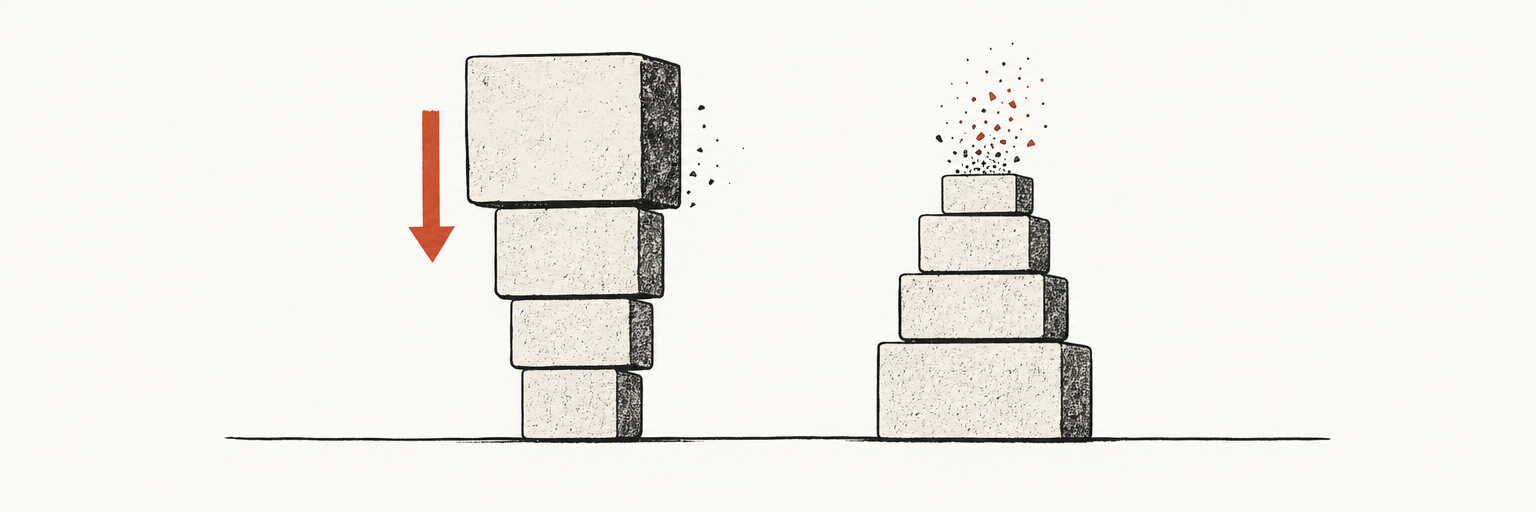
Both the debt avalanche and debt snowball are structured payoff strategies that use the same core mechanic: make minimum payments on all debts, then throw every extra dollar at one target debt. They differ only in which debt you target first.
How each method works
Debt avalanche: Target the debt with the highest interest rate first. Once it’s paid off, redirect that payment to the next-highest rate. Mathematically, this minimizes total interest paid and usually gets you out of debt faster.
Debt snowball: Target the debt with the smallest balance first, regardless of interest rate. Once it’s paid off, roll that payment into the next-smallest balance. Each payoff happens faster because you’re starting with the smallest targets.
The mechanics are identical — both require maintaining minimum payments everywhere else and concentrating extra payments on the target debt.
Comparing with a real example
Suppose you have three debts:
| Debt | Balance | Interest rate | Minimum payment |
|---|---|---|---|
| Credit card A | $2,500 | 24% APR | $60 |
| Credit card B | $8,000 | 18% APR | $160 |
| Personal loan | $5,000 | 11% APR | $110 |
With an extra $300/month to apply:
- Avalanche order: Credit card A (24%) → personal loan (11%) → credit card B (18%)
- Snowball order: Credit card A ($2,500) → personal loan ($5,000) → credit card B ($8,000)
In this example, the avalanche method saves roughly $400–600 in interest and finishes 1–3 months sooner (illustrative calculation based on the figures above). The snowball sequence is nearly identical here because the highest-rate debt also has the smallest balance — but the gap widens dramatically when the highest-rate debt has a large balance.
The psychology factor
Fidelity’s analysis of debt payoff behavior (fidelity.com/learning-center/personal-finance/avalanche-snowball-debt) identifies the key tradeoff: the avalanche is mathematically optimal, but the snowball has a documented psychological advantage. Each zero-balance account is a concrete win that reinforces the habit. Research from the Harvard Business Review found that consumers who pay off smaller balances first are more likely to eliminate debt completely, even though they pay more in interest along the way.
Neither finding cancels the other out — the question is which matters more for your specific situation.
How to choose
Use the avalanche if:
- Your highest-rate debt also has a manageable balance (so you’ll see progress early anyway)
- You’re motivated by math and long-term optimization
- You’re comfortable tracking a strategy with fewer visible milestones
Use the snowball if:
- You’ve tried and abandoned debt payoff plans before
- Your highest-rate debts have very large balances that will take years to clear
- You need visible wins to stay motivated month to month
Either method is far better than making only minimum payments. On a $8,000 credit card at 18% APR with a $160 minimum payment, paying the minimum alone takes over 25 years and costs more than $8,000 in interest. Any extra payment applied to the principal dramatically shortens both the timeline and the total cost.
Getting started
- List all debts with their current balances, interest rates, and minimum payments
- Pick a method (avalanche or snowball) based on your motivation style
- Calculate the total minimum payment across all debts
- Determine how much extra you can add above minimums
- Direct all extra payments to the target debt; maintain minimums on everything else
- When the target is paid off, add its full payment to the next target (this is the “roll” in both strategies)
A free debt payoff calculator can show you the exact timeline and interest cost for each approach given your specific debts — useful for seeing the difference before committing.