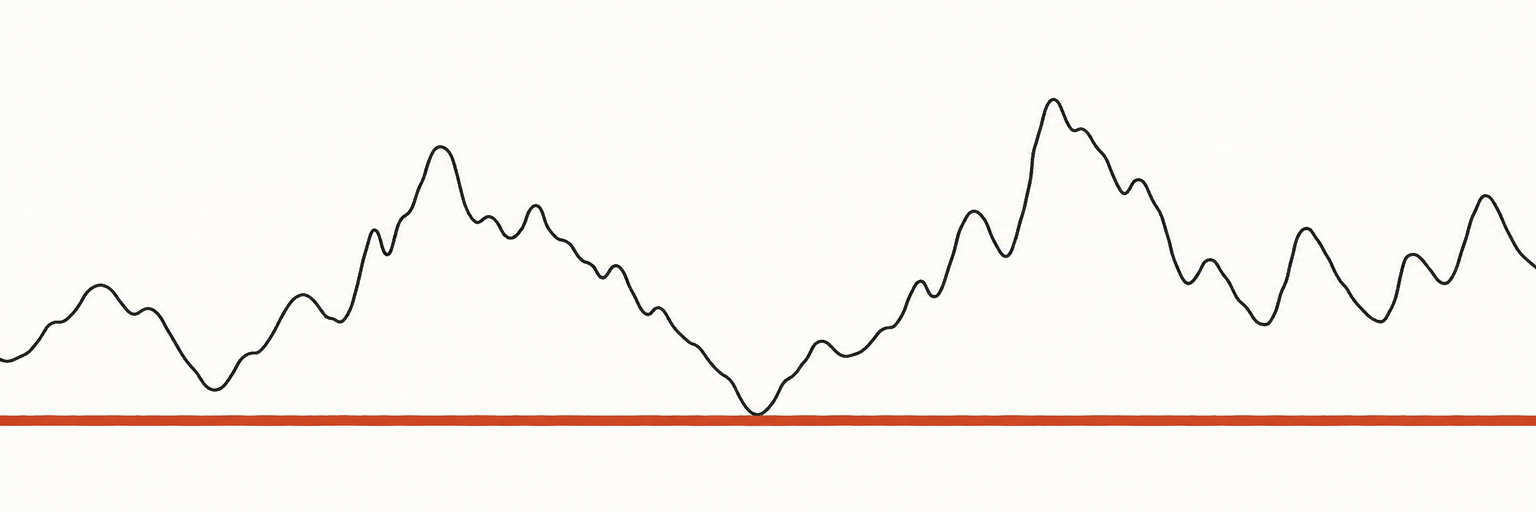
Budget off your lowest reliable month — not your average, and not your best — then treat every dollar above that floor as an allocation decision you make when it arrives. This is the core adjustment that makes budgeting workable on irregular income.
Who has irregular income
According to the U.S. Bureau of Labor Statistics, approximately 15 million Americans were self-employed in 2023, representing about 9.5% of the total workforce. Add gig workers, commission-based employees, seasonal workers, and part-time freelancers and the number of people without predictable paychecks is substantially larger. The Federal Reserve’s 2023 Report on the Economic Well-Being of U.S. Households found that 35% of adults experienced income volatility over the prior 12 months.
Traditional budgeting advice assumes a fixed monthly paycheck. If your income varies by $2,000–$5,000 month to month, that advice doesn’t translate directly — it requires a structural adjustment.
Step 1: Find your income floor
Look at your last 12 months of gross income. Remove any one-off outliers — a single large project, a month where you were sick, a contract that won’t recur. Find the lowest representative month. That number is your income floor — the amount you’ll design your essential spending around.
If you’re newer to irregular income and don’t have 12 months of history, use a conservative estimate: 70–75% of what you think a typical month looks like. Lower is safer than higher.
Example: Your last 12 months of net income were: $3,200 / $4,100 / $2,800 / $5,600 / $3,400 / $3,000 / $4,800 / $2,900 / $3,700 / $6,200 / $3,500 / $4,000. Removing the outlier months ($6,200 was a one-time contract; $2,800 was a slow vacation month), your income floor is approximately $3,000.
Step 2: Cover fixed expenses first
Your income floor must cover every non-negotiable cost:
- Rent or mortgage
- Utilities (use a yearly average divided by 12)
- Insurance premiums
- Minimum debt payments
- Groceries (estimate conservatively)
- Phone and internet
If the floor doesn’t cover these, that’s the first problem to solve — either reduce fixed costs or establish a more reliable income floor through a part-time consistent income stream.
Step 3: Build a holding account
Irregular income requires a buffer account. When a large payment arrives, don’t treat it as immediately spendable. Route income into a dedicated holding account (a separate high-yield savings account works well), then pay yourself a consistent monthly draw equal to your income floor.
This separates the timing of earning from the timing of spending — the core challenge of variable-income budgeting. The goal is to function as your own employer, paying yourself a regular “salary” regardless of when client payments arrive.
A holding account of 2–3 months’ worth of expenses is the minimum. This means you can weather two consecutive lean months without missing fixed payments.
Step 4: Allocate surplus months intentionally
When income exceeds your floor, deploy the surplus in priority order before it disappears into general spending:
| Priority | Destination | Target amount |
|---|---|---|
| 1 | Fill holding account to 2–3 month buffer | Up to 3× monthly expenses |
| 2 | Emergency fund | 3–6 months of expenses |
| 3 | Estimated quarterly taxes (self-employed) | 25–30% of gross income |
| 4 | Retirement contributions | IRS max: $7,000/year Roth IRA (2024) |
| 5 | Extra debt payments | Highest-interest debt first |
| 6 | Discretionary savings goals | Vacation, equipment, car |
The rule: surplus months are not permission to increase lifestyle spending until the first four priorities are consistently met.
Step 5: Budget monthly, not annually
Avoid averaging annual income across 12 equal months in your head. Budget what you actually have available each month. If January deposits $2,000 into your holding account and February brings $6,000, February’s discretionary allocation gets more — but only after the priority list above is addressed.
| Month | Income | Floor draw | Surplus | Priority allocation |
|---|---|---|---|---|
| January | $2,400 | $3,000 | $0 (deficit) | Draw from holding account |
| February | $5,800 | $3,000 | $2,800 | Emergency fund + taxes |
| March | $3,200 | $3,000 | $200 | Add to holding account |
| April | $7,100 | $3,000 | $4,100 | Taxes + retirement + debt |
Handling taxes as a self-employed person
If you’re self-employed, federal and state income taxes are not withheld from payments. The IRS requires quarterly estimated tax payments (due in April, June, September, and January). Failing to pay or underpaying results in penalties.
Set aside 25–30% of every gross payment into a dedicated tax savings account the moment it arrives. This percentage covers federal self-employment tax (15.3% on net self-employment income) plus federal income tax. Adjust upward if your state has significant income tax.
The monthly salary method
Set a target monthly draw based on your income floor. When income exceeds that draw in a given month, leave the excess in the holding account. Only permanently raise your monthly draw when you’ve maintained a higher income floor consistently for 3+ months in a row. This prevents lifestyle inflation during good stretches, which is the most common way variable-income earners end up in financial trouble despite earning good averages.
Common mistakes
Budgeting from average income instead of floor income. If your average is $4,500 but your worst months are $2,800, budgeting $4,500 means two bad months in a row breaks your fixed obligations.
Spending big months immediately. A $10,000 month looks like wealth. Three months later, two $2,500 months in a row look like a crisis. The holding account prevents this whipsaw.
Forgetting quarterly taxes until they’re due. New freelancers frequently discover a $4,000–$8,000 tax bill at year end because they treated all income as take-home pay. Segregate taxes from the first payment.
Setting a monthly draw too high, too soon. Increasing your salary draw based on one or two good months, rather than a sustained new floor, leaves the holding account underfunded for the next slow period.
Variable income and retirement savings
One underappreciated challenge for self-employed and gig workers is that there is no employer 401(k) match, no automatic payroll deduction for retirement, and no annual contribution made by default. Retirement saving is entirely self-initiated.
Self-employed individuals have access to several retirement accounts with higher contribution limits than standard IRAs:
- SEP-IRA: Contribute up to 25% of net self-employment income, maximum $69,000 (2024). Simple to set up, flexible contributions — you can contribute more in high years and less in low years.
- Solo 401(k): Available to self-employed individuals with no employees. Allows both employee and employer contributions, higher combined limits than a SEP-IRA for moderate income levels.
- Traditional or Roth IRA: $7,000/year limit (2024). Less powerful than the above for higher earners, but a good starting point.
In months with surplus, retirement contributions belong in the priority list above discretionary spending increases. The combination of no employer match and inconsistent contributions is the primary reason self-employed workers retire with significantly less than comparable salaried employees — despite sometimes higher gross income during peak years.
Next action
Open a second savings account labeled “Income Holding” if you don’t have one. The next payment you receive, deposit it there instead of checking. Then transfer your income floor amount to checking for the month. That single structural change — separating income receipt from spending availability — is the foundation of the whole system. Everything else follows from it.