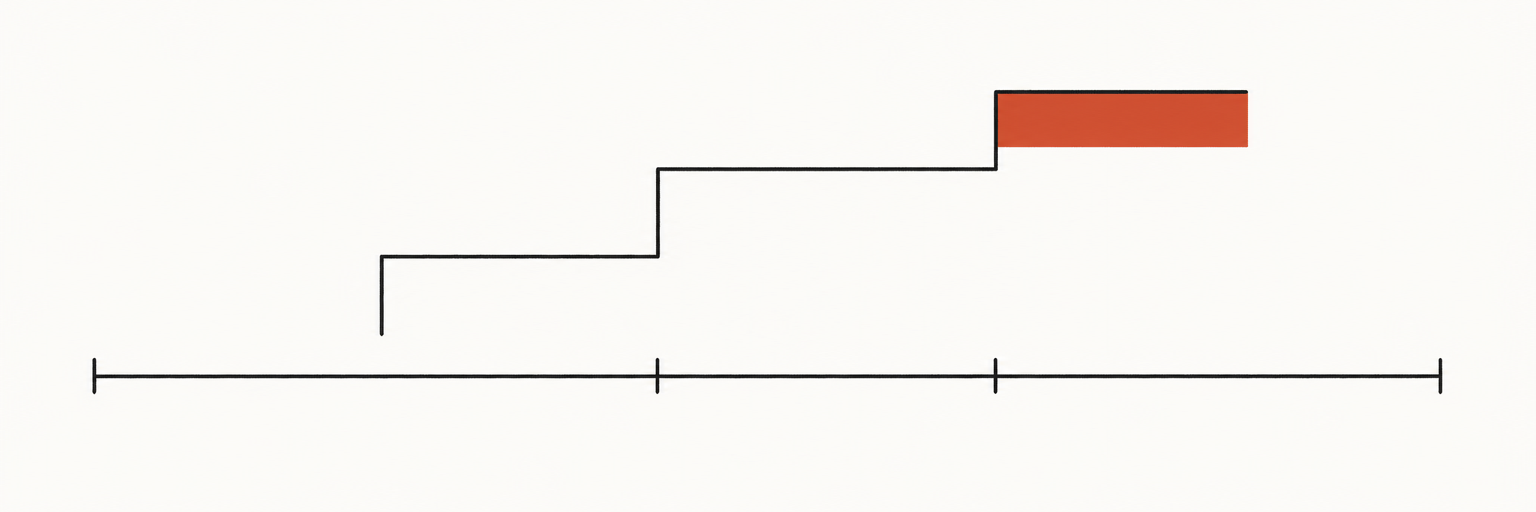
Credit building is a slow, predictable process. Unlike paying off a debt balance — which you can accelerate with extra payments — the time component of credit history cannot be rushed. You simply have to accumulate months and years of consistent behavior.
The minimum threshold is six months to generate a FICO score at all. Reaching a “good” score of 670+ realistically takes one to two years of responsible management. A score above 740 (“very good”) generally takes two to five years.
The minimum threshold: six months
To generate a FICO score, your credit file must include:
- At least one account that has been open for six months or more
- At least one account reported to the bureaus within the past six months
Before hitting that six-month mark, you are “credit invisible” — lenders have no score to pull, which is functionally the same as having bad credit for most applications.
VantageScore can generate a score in as little as one month of reported activity, which is why some free credit monitoring tools show a number before FICO is ready. VantageScore is used by some lenders and many free tools (Credit Karma, for example), but most banks and major credit card issuers rely on FICO for underwriting decisions.
Timeline to each score tier
| Timeframe | Realistic score range | What it unlocks |
|---|---|---|
| 1–3 months | VantageScore only; no FICO yet | Limited — some secured cards |
| 3–6 months | Approaching FICO eligibility | Secured cards, credit-builder loans |
| 6–12 months | 580–650 (fair) first FICO | Basic credit cards, some auto loans |
| 12–24 months | 650–700 (good) | Most credit cards, competitive auto loans |
| 2–4 years | 700–750 (very good) | Better rates, higher limits |
| 4+ years | 750+ (excellent) | Best rates on mortgages, premium cards |
These ranges assume consistent on-time payments, low utilization, and no derogatory marks throughout. A single missed payment at month 10 can push the timeline back by six to twelve months.
The five FICO factors and how long each takes
Understanding what FICO actually measures helps clarify why the timeline is what it is:
| FICO factor | Weight | Time dependency |
|---|---|---|
| Payment history | 35% | Builds immediately; one missed payment can set you back months |
| Amounts owed (utilization) | 30% | Changes monthly; respond within one billing cycle |
| Length of credit history | 15% | Requires calendar time — cannot be accelerated |
| Credit mix | 10% | Improves when you add installment loan alongside revolving credit |
| New credit | 10% | Hard inquiries age off after 12 months |
The 15% length-of-history component is the one that truly can’t be rushed. The 30% utilization component is the most responsive to action.
What accelerates the process
On-time payments are non-negotiable. Payment history is 35% of your FICO score. A single 30-day late payment can drop a score by 50–100 points depending on how established the file is, and the damage lingers for years.
Becoming an authorized user on a well-managed, old credit card account belonging to a family member or partner can add that account’s entire positive history to your file — sometimes within 30–45 days of being added. This is the only legitimate shortcut that can significantly compress the timeline. You don’t need to use the card, or even receive it. One important caveat: if the primary cardholder ever misses a payment, that negative history transfers to you too.
Using a secured card and a credit-builder loan together builds both revolving and installment credit simultaneously, which benefits your credit mix and creates two separate streams of positive payment history. A CFPB study found that people with no prior credit who opened a credit-builder loan saw their probability of having a credit score increase by 24%.
Keeping utilization below 10% on any revolving accounts accelerates score gains faster than the commonly cited 30% threshold. People with FICO scores above 800 carry an average utilization of around 4%.
What you cannot speed up
- The age of your oldest account — this is fixed
- The average age of all accounts — which actually drops temporarily when you open new accounts
- The two-year window for hard inquiries to fall off your report
- The seven-year window for negative items (late payments, collections) to age off
Length of credit history accounts for 15% of your FICO score and requires calendar time. Opening many accounts quickly can paradoxically lower your average account age and slow your progress.
Rebuilding vs. starting from zero
The timeline differs significantly depending on your starting point:
Starting from zero (no credit history): Plan on 12–18 months to reach the “good” range (670+). Open a secured card, use it lightly, pay it in full, and add a credit-builder loan after 3–6 months for credit mix.
Rebuilding after serious delinquency: The timeline stretches considerably. You’re fighting the drag of existing negative marks while simultaneously trying to add positive history. A single collection account or 90-day late payment can take two to four years to recover from, even with perfect behavior afterward. The negative item stays on your report for seven years, but its score impact diminishes over time — particularly in years four through seven.
Rebuilding after bankruptcy: Chapter 7 bankruptcy stays on your report for ten years. Scores typically bottom out right after discharge, then gradually improve. Many people reach the 650–680 range within two to three years of discharge with consistent positive behavior.
Realistic expectations by starting scenario
| Starting scenario | Time to 670+ | Time to 740+ |
|---|---|---|
| No credit history (secured card approach) | 12–18 months | 3–5 years |
| Authorized user on old account | 6–12 months | 2–4 years |
| Rebuilding after late payments | 18–36 months | 4–6 years |
| Rebuilding after bankruptcy | 3–5 years | 6–8 years |
Common mistakes
- Opening multiple accounts at once: Stacking hard inquiries and reducing your average account age can stall progress early on. Open one account, establish history, then consider adding a second.
- Closing your first account prematurely: Your oldest account anchors your credit age. Keep it open even after you qualify for better cards.
- Carrying a balance to “build credit” faster: Interest charges don’t accelerate credit building. Paying in full every month builds history just as effectively and costs nothing.
- Ignoring utilization: Opening a secured card and immediately using 80% of the limit actively hurts your score during the build period.
Next step
If you have no credit at all, open a secured credit card this month. Set it up with one small recurring charge — a streaming subscription or a single monthly bill — and configure autopay for the full statement balance. After six months, you’ll have your first FICO score. After 12 months of on-time payments and low utilization, you should be in the 640–680 range and eligible for an unsecured card with better terms.