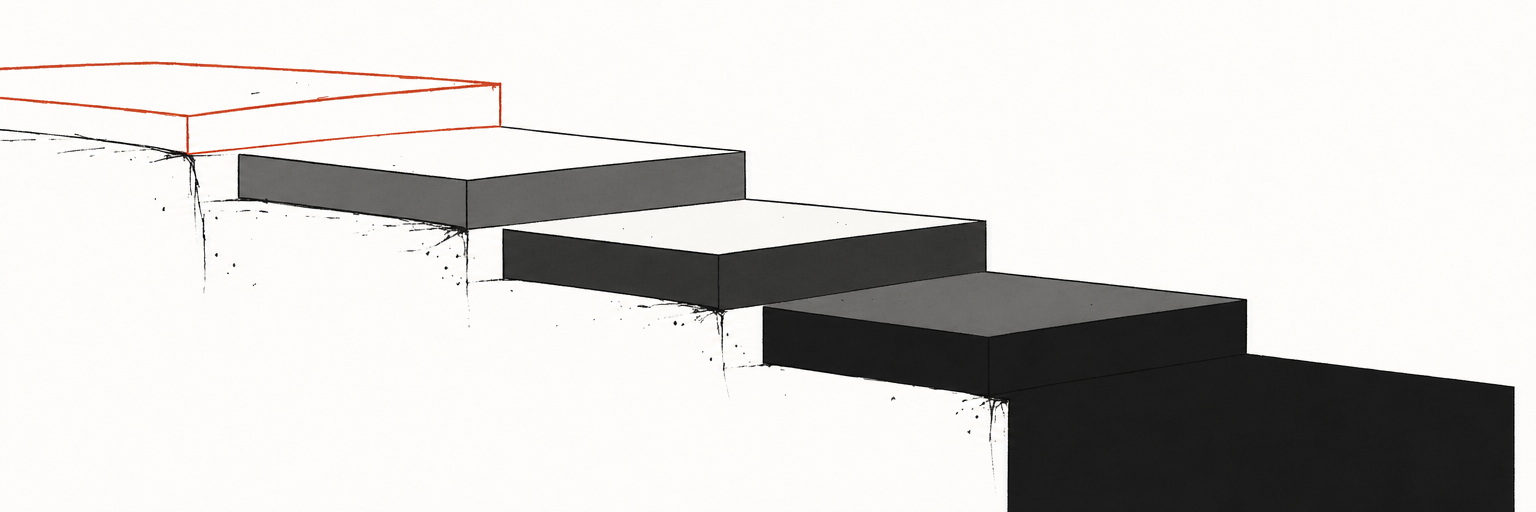
Missing a credit card payment sets off a sequence of escalating consequences. The timeline is predictable, and each stage is harder to recover from than the last.
The timeline after you stop paying
| Stage | Timing | What happens |
|---|---|---|
| Late fee charged | Day 1 after due date | $30–$41 per missed payment |
| Penalty APR triggered | After 1–2 missed payments | Up to 29.99% on entire balance |
| Credit bureaus notified | 30 days past due | Score drops 60–110 points |
| Aggressive collections | 60–90 days | Daily calls, card suspended |
| Charge-off | ~180 days | Issuer writes debt off as loss; debt sold |
| Lawsuit possible | 180+ days | Civil judgment, garnishment, liens |
| Credit report damage | 7 years | All delinquencies visible to lenders |
Days 1–30: Late fees and penalty rate
The day after your due date, you are late. Card issuers currently charge late fees in the $30–$41 range per missed payment — the CFPB’s rule capping fees at $8 was vacated by a federal court in April 2025, leaving the previous higher amounts in effect for most large issuers (CFPB, 26 C.F.R. § 1026.52).
If you miss two consecutive payments, many issuers invoke a penalty APR — a punitive interest rate that can reach 29.99% annually. This rate typically applies to your entire existing balance, not just future purchases, and under federal law it can remain in effect indefinitely as long as the account is delinquent. A $5,000 balance accruing at 29.99% generates roughly $125 in interest charges every single month — before you make a single payment toward principal.
Days 30–60: Credit score damage begins
A payment 30 or more days late is reported to the three major credit bureaus (Equifax, Experian, TransUnion). At this point, payment history — the single largest factor in your FICO score, accounting for 35% — takes a hit. A single 30-day late payment can drop a score that was in the “good” range (670–739) by 60–110 points, according to FICO research. The higher your score before the missed payment, the larger the drop.
The delinquency is reported to bureaus every month it continues. Each additional 30-day increment — 60 days late, 90 days late — compounds the damage.
Days 60–90: Collections escalation
Issuers typically shift to more intensive in-house collections after two or three missed payments. Expect more frequent phone calls, written notices, and suspension of your ability to use the card. Some issuers at this stage reduce or close your credit line, which further affects your credit utilization ratio and score.
Under the Fair Debt Collection Practices Act (FDCPA), once an account is transferred to a third-party collector, collectors cannot call before 8 a.m. or after 9 p.m., or call your workplace if you tell them not to. These protections do not apply to first-party collections by the original issuer.
Days 90–180: Charged off
After roughly six months of non-payment, the issuer charges off the account. A charge-off is an accounting move: the issuer writes the debt off as a business loss. It does not erase what you owe. The balance — including accumulated interest and fees — remains legally collectible.
After charge-off, one of two things happens: the issuer assigns the account to an internal collections unit, or sells it to a third-party debt buyer for cents on the dollar. Debt buyers pay 4–14 cents per dollar of face value, according to the FTC, then pursue collection themselves. The charge-off notation on your credit report is one of the most damaging entries a file can carry.
After 180 days: Lawsuit and judgment
The card issuer or any subsequent debt buyer can sue you in civil court for the unpaid balance. The statute of limitations — the window in which a lawsuit is legally permitted — varies by state. According to the FTC, most states set this window between 3 and 10 years:
- Shortest limits: Delaware, New Hampshire (3 years); California, Texas (4 years)
- Longest limits: Illinois, Iowa, Louisiana, Missouri, Rhode Island (10 years)
If the creditor wins a judgment against you, they can:
- Garnish your wages — up to 25% of disposable income in most states under federal law (15 U.S.C. § 1673)
- Levy your bank account — drain funds up to the judgment amount
- Place a lien on real property — preventing you from selling or refinancing without satisfying the debt
Important: making any payment on a debt — even $1 — can restart the statute of limitations clock in many states.
Credit report: 7 years
Late payments, the charge-off notation, and any resulting collection account all remain on your credit report for seven years from the date of first delinquency, regardless of whether the debt is paid or settled. This affects loan eligibility, apartment applications, and in some industries, employment background checks.
What to do instead of going silent
The CFPB recommends contacting your card issuer as soon as you know you cannot make a payment — before you miss it. Most major issuers have hardship programs that are not widely advertised but are accessible by phone. These may include:
- Temporarily reduced interest rates (sometimes to 0%)
- Waived late fees for a set period
- Reduced minimum payment requirements
- Payment deferrals for documented emergencies
These options are typically available only before charge-off. Once the account is written off, the issuer has already taken the accounting loss and has less incentive to offer favorable terms.
If you need independent help negotiating with creditors, the National Foundation for Credit Counseling (NFCC) — a nonprofit network founded in 1951 — connects consumers with certified credit counselors. Setup fees are typically $50 or less, with monthly fees around $25. A counselor can facilitate a Debt Management Plan (DMP) in which the agency negotiates reduced interest rates with multiple creditors on your behalf and you make a single monthly payment to the agency.
If you’re already behind
- One missed payment: Pay it immediately if possible. Call the issuer and ask for the late fee waived — issuers routinely grant this for first-time incidents.
- Two to four missed payments: Call and ask specifically about hardship programs before charge-off occurs. Ask what your options are before the account hits 180 days.
- Post-charge-off: The debt is now with a collection department or debt buyer. You can still negotiate — debt buyers often settle for 25–50 cents on the dollar. Get any settlement agreement in writing before paying.
Common mistakes when you stop paying
- Going silent: Ignoring calls and letters doesn’t stop the timeline — it just means you miss chances to negotiate.
- Paying just enough to avoid the statute of limitations restarting: Any payment can reset the clock in many states. Understand your state’s rules before making partial payments on very old debt.
- Closing the account yourself: Closing an account does not stop interest from accruing on the balance or erase the delinquency history.
- Assuming a charge-off means the debt is gone: It isn’t. Charged-off debts are actively collected and can result in lawsuits years later.
- Ignoring a lawsuit summons: Failing to respond to a civil lawsuit results in a default judgment against you — giving the creditor full legal enforcement powers with no opportunity to contest the amount.
Your next step
If you cannot make a minimum payment this month, call the number on the back of your card today. Ask: “Do you have a hardship program?” Write down the name of who you spoke with and what they offered. If you owe across multiple cards and the total is unmanageable, call the NFCC at 1-800-388-2227 for a free counseling session.