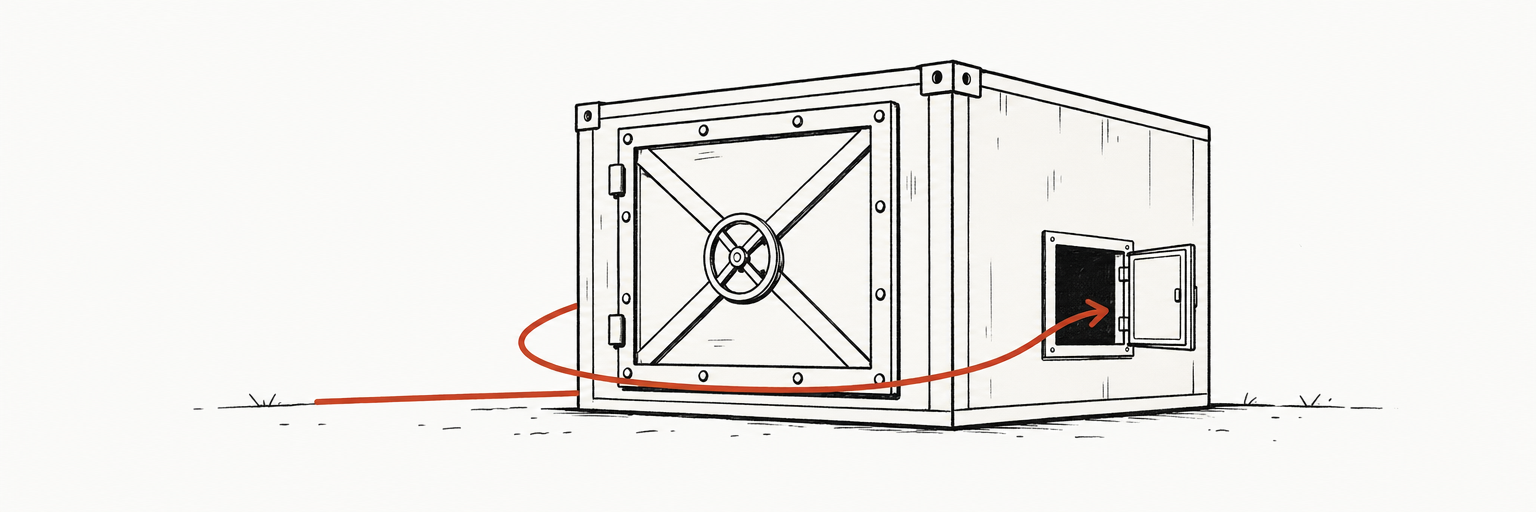
A backdoor Roth IRA is a workaround for high earners who can’t contribute directly to a Roth IRA because their income exceeds IRS limits. It involves two steps: contribute to a traditional IRA without taking a tax deduction, then convert that money to a Roth IRA. The result is money in a Roth account growing tax-free, despite not qualifying for a direct Roth contribution.
Why it exists: Roth IRA income limits
For 2025, direct Roth IRA contributions phase out and eventually disappear for single filers with a modified adjusted gross income (MAGI) above $150,000 (eliminated at $165,000) and for married filing jointly above $236,000 (eliminated at $246,000). Traditional IRA contributions have no income limit — anyone can contribute. And IRA conversions to Roth have no income limit either.
The backdoor Roth IRA takes advantage of these two facts.
How to do it: two steps
Step 1: Make a nondeductible traditional IRA contribution. The 2025 limit is $7,000 ($8,000 if you’re 50 or older). Because you’re over the Roth income limit, you don’t take a deduction — this is an after-tax contribution. File IRS Form 8606 to document that the contribution was nondeductible.
Step 2: Convert to Roth. Contact your IRA custodian and request a Roth conversion of the traditional IRA balance. If you do this shortly after the contribution (while the only money in the traditional IRA is the fresh after-tax contribution), the conversion is tax-free because you’ve already paid tax on those dollars.
The pro-rata rule: the main complication
If you have other traditional IRA money — from previous deductible contributions or rollovers from a former employer’s 401(k) — the pro-rata rule applies. The IRS treats all your non-Roth IRAs as one combined account when determining the taxable portion of a conversion.
Example: You have $93,000 in an old rollover IRA (pre-tax) and you make a $7,000 nondeductible contribution, giving you $100,000 total in traditional IRAs. If you convert $7,000, only 7% of that conversion ($490) is tax-free. The other $6,510 is taxable — proportional to the share of pre-tax money across all your traditional IRAs.
This makes the backdoor Roth much less clean if you have existing traditional IRA balances.
| Scenario | Tax on $7,000 conversion |
|---|---|
| No other traditional IRA balances | $0 (fully tax-free) |
| $93,000 in rollover IRA + $7,000 new | ~$6,510 taxable |
| $200,000 in rollover IRA + $7,000 new | ~$6,769 taxable |
Who it’s right for
The backdoor Roth makes the most sense for people who:
- Earn above the Roth IRA income phaseout ($165,000 single / $246,000 married in 2025)
- Have no pre-existing traditional IRA, SEP IRA, or SIMPLE IRA balances (or can roll them into a 401(k) to clear the pro-rata complication)
- Want tax diversification in retirement alongside pre-tax 401(k) money
If you have substantial traditional IRA balances that can’t be moved to a 401(k), the pro-rata rule may make the strategy less tax-efficient than it appears.
The rollover workaround
One way to sidestep the pro-rata rule: if your current employer’s 401(k) plan accepts incoming rollovers, roll your traditional IRA money into the 401(k). This removes it from the pro-rata calculation. After the rollover, the backdoor Roth contribution and conversion proceed cleanly.
Check with your plan administrator whether incoming rollovers are allowed before counting on this approach.
Timing and paperwork
The IRS requires you to file Form 8606 each year you make a nondeductible IRA contribution. Keep records of all nondeductible contributions across years — this basis tracks the after-tax money and determines how much of any future conversion is tax-free. Missing or incorrect Form 8606 filings can create tax problems years later.