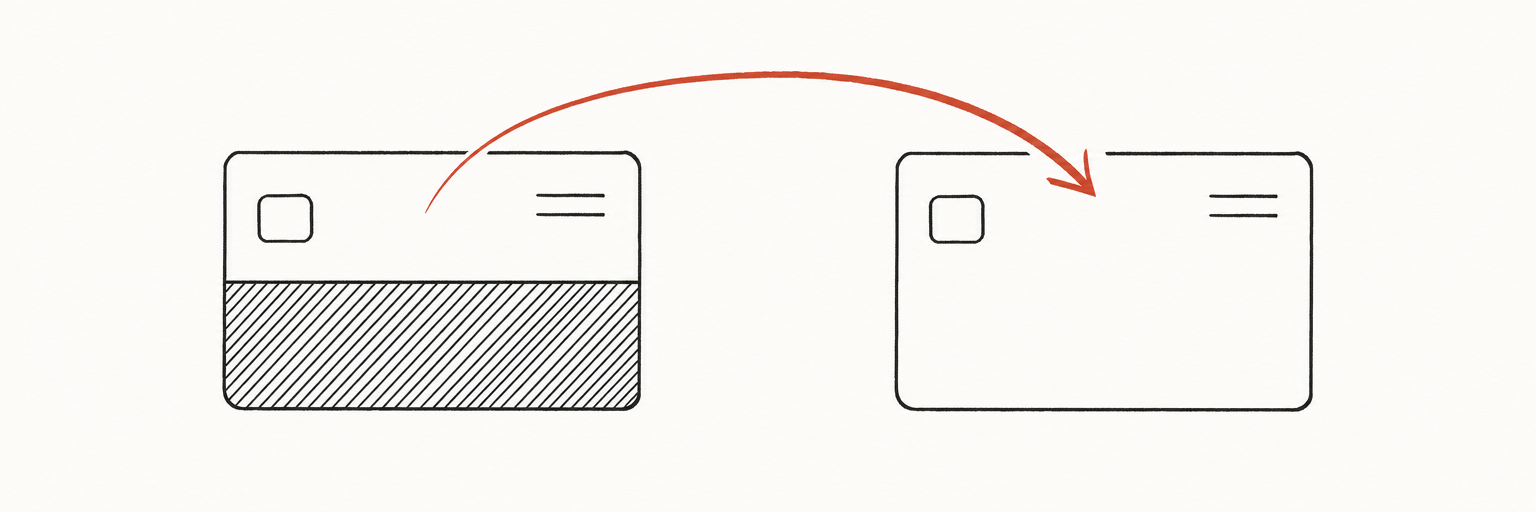
A balance transfer credit card is a card that accepts debt moved from another card and charges 0% — or a very low rate — on that transferred balance for a set introductory period. Instead of paying 24% APR on your current card, you pay nothing for 12, 15, or 21 months, giving you a window to pay down principal without interest compounding on top.
How a balance transfer works
- Apply for a balance transfer card (good credit typically required — 670+ FICO score)
- Request a transfer from your old card to the new one, usually online or by phone within days of account opening
- The new card pays off your old card and you now owe the new card
- You pay down the balance during the 0% promotional period
- Whatever balance remains when the promo ends begins accruing the card’s regular APR
The transfer fee — typically 3–5% of the amount moved — is charged immediately and added to your balance. Per the CFPB, this fee is permitted even on 0% promotional offers. There is no way to avoid it on most cards, though a small number of cards advertise no-fee transfers (usually with shorter intro periods).
Current market rates (April 2026)
| Card | 0% Intro period | Transfer fee | Standard APR after promo |
|---|---|---|---|
| Citi Diamond Preferred | 21 months | 3% intro, then 5% | 16.49%–27.24% variable |
| Wells Fargo Reflect | 21 months | 5% | 17.49%–28.24% variable |
| Chase Slate Edge | 21 months | 3% intro (120 days) | 18.24%–28.24% variable |
| Discover it Chrome | 18 months | Standard | 17.49%–26.49% variable |
| Chase Freedom Unlimited | 15 months | Standard | 18.24%–27.74% variable |
Most issuers require the transfer to be initiated within 60–120 days of account opening to qualify for the introductory rate. Transfers after that window typically receive the card’s standard APR.
Worked example: $6,000 at 24% APR
Suppose you have $6,000 on a card charging 24% APR, and you transfer it to a card with a 3% fee and 21 months at 0%.
Transfer fee: $6,000 × 3% = $180 (added to your balance, bringing it to $6,180)
Required monthly payment to pay off in 21 months: $6,180 ÷ 21 = $294/month
What you save: At 24% APR, paying $294/month on $6,000 takes 25 months and costs roughly $1,450 in interest. With the balance transfer, you pay $180 upfront and $0 in interest — net savings of approximately $1,270.
| Scenario | Upfront fee | Interest paid | Total cost | Months to pay off |
|---|---|---|---|---|
| Balance transfer (0%, 21 mo) | $180 | $0 | $6,180 | 21 |
| Stay on current card (24% APR) | $0 | ~$1,450 | ~$7,450 | 25 |
| Minimum payments only (24% APR) | $0 | ~$4,200+ | ~$10,200+ | 60+ |
The math favors a balance transfer whenever you can realistically pay off most of the balance within the promotional window.
How to calculate your break-even
The transfer fee is certain. The interest savings depend on how fast you pay. Use this formula to find the break-even monthly payment:
Minimum payment needed to break even = Transfer fee ÷ Months in promo period
For a $5,000 balance at 3% fee ($150) over 15 months: you break even paying $10/month more than you otherwise would have. At any payment above that, the transfer saves money. The higher and faster you pay, the better the economics.
The rules you need to know
The promotional period has a hard end date. The CFPB requires issuers to honor the promotional rate for at least six months, and it cannot be ended early unless you are more than 60 days late on a payment. Being even one day late does not trigger an early end — only 60+ day delinquency does.
New purchases may not get the 0% rate. This is the most common source of confusion. If you make new purchases on a balance transfer card while carrying a transferred balance, those purchases often start accruing interest immediately at the standard APR. The CFPB notes that this catches many cardholders off guard. The safest approach: do not use a balance transfer card for any new spending.
Minimum payments are still required. The 0% rate does not mean you can skip payments. Missing a minimum payment restarts the interest clock — and may trigger penalty rates on the entire balance.
The standard APR after the promo is often high. Cards marketed as balance transfer vehicles frequently carry ongoing APRs of 17–28%. Any remaining balance when the intro period ends becomes expensive immediately. Plan your payoff to finish before the deadline, not on it.
What credit score do you need?
Most cards offering 0% introductory periods for 15+ months require a FICO score of 670 or higher (the “good credit” threshold). The longest promotional periods — 18 to 21 months — generally require scores of 700 or above. Some issuers also look at:
- Debt-to-income ratio below 40%
- No recent bankruptcies or severely delinquent accounts
- Limited recent applications for new credit
If your score is below 670, you may still qualify for balance transfer offers but with shorter promotional periods (12–15 months) or higher transfer fees.
Who should use a balance transfer card
A balance transfer works well when all of these are true:
- Your FICO score is 670 or above
- You have a concrete, month-by-month payoff plan that eliminates the balance before the promo ends
- The interest savings clearly outweigh the transfer fee (they almost always do on balances above $1,000)
- You can commit to not adding new purchases to the card
- You won’t be applying for a mortgage or other major credit within 12 months (the new account temporarily lowers the average age of your accounts)
Who should skip it
- People who will carry the balance past the promo period without a realistic payoff plan — you’ll end up paying 17–28% on whatever remains
- Anyone who will use the freed-up old card to accumulate new debt, ending up with two balances instead of one
- People with scores below 670 who are unlikely to be approved for the best offers
- Anyone within 6–12 months of applying for a mortgage, where the new account and hard inquiry can matter
What happens to the old card
Once the balance transfers, your original card has a $0 (or near-zero) balance. Keep it open — closing it reduces your total available credit and can raise your credit utilization ratio, both of which hurt your score. Do not use it to accumulate new spending while you’re paying off the transfer.
Common mistakes
- Transferring without a payment plan: The 0% period creates urgency — divide the balance by the number of promo months and make that your minimum payment, not the card’s stated minimum (which is often just 1–2% of the balance and will not pay it off in time).
- Missing the transfer window: Most cards require you to initiate the transfer within 60–120 days of opening the account. Transfer requests after that deadline receive the standard APR.
- Assuming all balances transfer: You can generally only transfer balances from a different issuer. You cannot transfer a Chase balance to another Chase card, for example.
- Ignoring the fee on large balances: On a $20,000 balance, a 5% transfer fee costs $1,000 upfront. Verify the math before assuming the transfer is worthwhile.
Your next step
Gather: your current card’s balance, its APR, and the number of months you can realistically commit to a fixed monthly payment. Then use the break-even formula above to check whether a balance transfer saves money at your payment pace. If it does, apply for a card that matches your credit profile and offers a promo period long enough for your payoff plan.