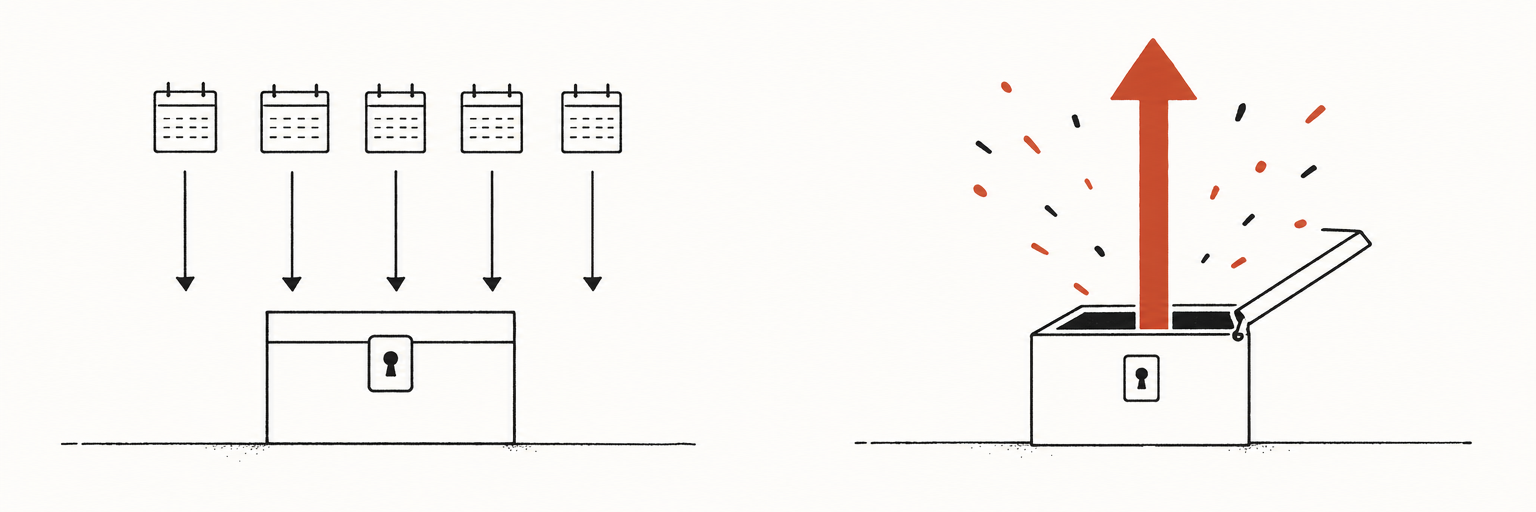
A credit-builder loan is a loan designed specifically to establish or improve your credit score — not to give you money upfront. The mechanics are the opposite of a traditional loan: instead of receiving funds and then repaying them, you make payments first and receive the money at the end.
If you have no credit history and can reliably make monthly payments, a credit-builder loan is one of the most effective tools available — a CFPB study found it increased the probability of having a credit score by 24% and raised scores by an average of 60 points for people without existing debt.
How it works
- A bank, credit union, or online lender places $300–$1,000 into a locked savings account in your name
- You make fixed monthly payments over a term of 6–24 months (typically $25–$50/month)
- The lender reports each payment to the credit bureaus as an installment loan
- When the loan term ends, you receive the saved amount minus interest and any fees
The funds are inaccessible during the loan term — that’s intentional. You’re paying for the installment payment history that gets reported to the bureaus, not borrowing money for a specific use.
What the research shows
The CFPB conducted a study of 1,531 credit union members who opened credit-builder loans. Key findings:
- Opening a credit-builder loan increased the likelihood of having a credit score by 24% for people who had no prior credit file
- Participants without existing debt saw their scores increase by an average of 60 points
- Participants built an average savings balance of $253 over the loan term
- The product worked best for people starting from zero or with very thin files
A 60-point gain is substantive. It can be the difference between being declined for a basic credit card and qualifying for a card with reasonable terms. For someone starting at 580 (poor), a 60-point gain reaches 640 (fair) — enough to access most secured cards and some basic unsecured products.
The important caveat: existing debt matters
The same CFPB research found a meaningful difference based on existing debt levels:
- People without existing debt: average score gain of 60 points
- People with existing debt: slight negative effect on scores
Managing additional monthly payments on top of existing debt obligations caused some participants to miss payments — and a missed payment on any account causes more damage than a credit-builder loan can offset. If you’re currently managing debt you’re struggling to pay, address that first before adding a new loan obligation.
Typical loan terms and costs
| Term | Detail |
|---|---|
| Loan amount | $300–$1,000 (most common: $500) |
| Monthly payment | $25–$50 |
| Loan term | 6–24 months |
| APR range | 6–16% at credit unions; 15–30%+ at some online lenders |
| What you receive at end | Loan amount minus interest and fees |
APRs matter here because you’re paying interest on money you don’t have access to yet. A credit union charging 6–8% APR is meaningfully better than an online lender charging 25% on the same loan amount.
Where to find credit-builder loans
| Source | Notes |
|---|---|
| Credit unions | Most common source; lowest fees; member-focused; often 6–12% APR |
| Community banks | Some offer them; ask specifically by name |
| CDFIs (Community Development Financial Institutions) | Often serve lower-income borrowers; subsidized terms in some cases |
| Self (self.inc) | Online lender; higher APR than credit unions; widely accessible; no membership required |
| Local nonprofits | Some mission-driven organizations offer them as financial coaching tools |
Credit unions typically offer the best terms. Joining one usually requires living in a specific area, working for a certain employer, or belonging to an affiliated group — many are easy to join with minimal requirements. The NCUA’s credit union locator (mycreditunion.gov) helps find options near you.
Self.inc is frequently cited as an accessible option for people who can’t easily join a credit union. It functions like a standard credit-builder loan but charges higher fees. For most people, the difference in cost between Self and a credit union matters less than whether the product exists and is accessible.
Credit-builder loan vs. secured credit card
Both products build credit for people starting from zero. They build it differently:
| Credit-builder loan | Secured credit card | |
|---|---|---|
| Money upfront | No — you save as you pay | No — deposit held as collateral |
| Type of credit built | Installment (15% of FICO’s credit mix) | Revolving (affects utilization, 30% of FICO) |
| Minimum monthly cost | $25–$50 | $0 (if paid in full with zero interest) |
| Builds savings simultaneously | Yes | No |
| Credit mix benefit | Adds installment | Adds revolving |
| Flexibility of use | Fixed monthly payment | Variable — can charge any amount |
Credit mix accounts for 10% of your FICO score. Having both an installment account and a revolving account is better for your score than having two of the same type. Using a credit-builder loan alongside a secured credit card builds both types simultaneously — the fastest path to a well-rounded credit profile.
When a credit-builder loan is the better choice
Consider a credit-builder loan (instead of or alongside a secured card) when:
- You don’t have $200–$500 available for a secured card deposit
- You want to simultaneously build savings and credit
- You already have a secured card and want to add an installment account for credit mix
- You have no bank account, since some credit-builder loans require only a debit card or linked account, not a full checking account
When it won’t help
- If you’re likely to miss a monthly payment: one missed payment on a credit-builder loan causes more score damage than the loan can offset in several months of on-time payments
- If you’re carrying high-interest debt: the interest on a credit-builder loan is money that could pay down existing debt faster
- If you already have established installment credit: the credit mix benefit is minimal if you already have a mortgage or auto loan
Common mistakes
- Choosing an online lender without comparing credit union options first: The APR difference can mean paying significantly more over the loan term.
- Missing payments: A credit-builder loan only works if every payment is on time. Set up autopay before making the first payment.
- Closing the loan early: If you pay off early, reporting stops. Let the loan run its full term to maximize the history built.
- Using it as a substitute for addressing existing debt: It’s an addition to your financial strategy, not a replacement for managing current obligations.
Next step
Check whether there’s a credit union in your area you’re eligible to join (mycreditunion.gov). Ask specifically if they offer credit-builder loans and what their APR and terms are. If no credit union is accessible, compare Self.inc’s current terms. Open the loan, set up autopay for the monthly payment, and let it run to completion.