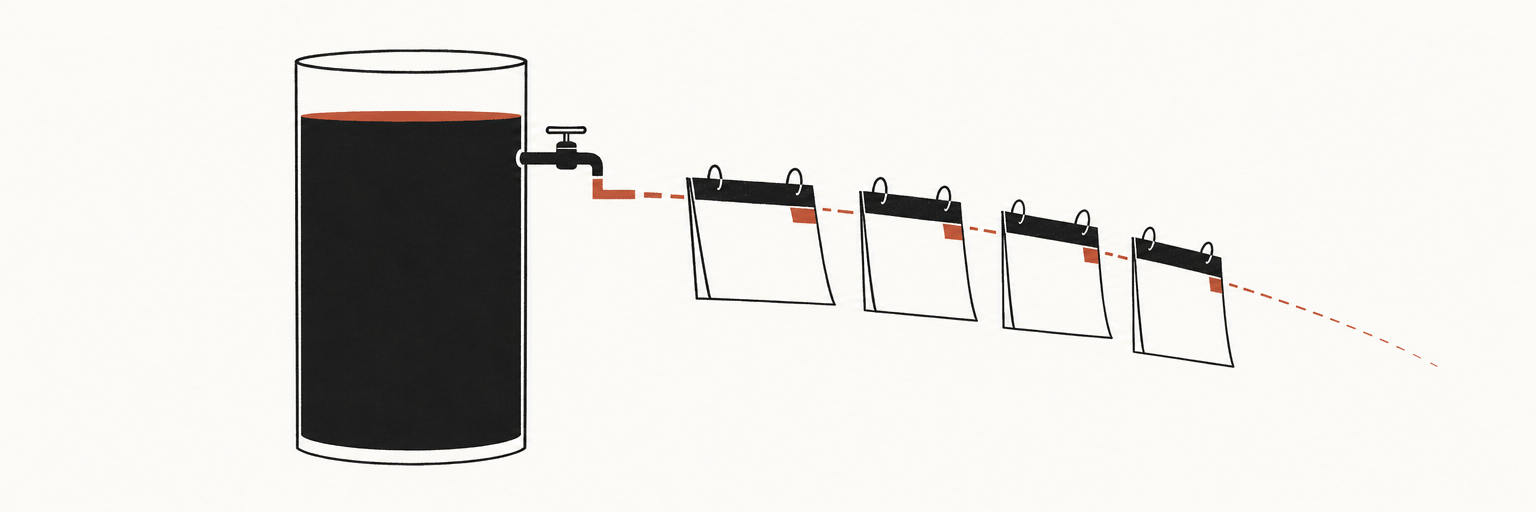
The IRS allowed you to defer taxes on traditional retirement accounts for decades. Required minimum distributions (RMDs) are how the government eventually collects those taxes. Starting at a specific age, you must withdraw a minimum amount each year from most tax-deferred retirement accounts — and pay ordinary income tax on whatever you take out. Missing the deadline triggers one of the steeper IRS penalties in the tax code.
Which accounts require RMDs
RMD rules apply to all of these:
- Traditional IRAs
- SEP IRAs
- SIMPLE IRAs
- 401(k) plans
- 403(b) plans
- 457(b) government plans
- Most other employer-sponsored defined-contribution plans
Important exception: Roth IRAs do not require RMDs during the account owner’s lifetime. Under SECURE 2.0 (enacted December 2022), Roth 401(k) and Roth 403(b) accounts are also exempt from RMDs starting in 2024 — one of the most significant changes from that legislation. You can leave the money to grow indefinitely without being forced to withdraw it.
When RMDs start: SECURE 2.0 age changes
The SECURE 2.0 Act raised the RMD starting age in two steps:
| Birth year | RMD starting age |
|---|---|
| Before 1951 | 70½ (original pre-SECURE rule) |
| 1951–1959 | 73 |
| 1960 or later | 75 (effective starting 2033) |
Under the current rules, if you were born in 1951 or later, you must begin taking RMDs by April 1 of the year following the year you turn 73.
After your first RMD, all subsequent distributions are due by December 31 of each year. If you delay your first RMD to April 1 of the following year, you will take two distributions in the same calendar year — one by April 1 and one by December 31. That double distribution can push you into a higher tax bracket and increase Medicare IRMAA surcharges. For most people, taking the first RMD in the year they turn 73 is the simpler approach.
Still working at 73? If you are actively employed and participating in your current employer’s 401(k), you may be able to delay RMDs from that specific plan until you actually retire. This exception does not apply to IRAs or to accounts held at former employers.
How the RMD amount is calculated
Each year’s RMD uses a simple formula:
RMD = Prior December 31 account balance ÷ IRS distribution period
The distribution period comes from the IRS Uniform Lifetime Table (Publication 590-B), which is based on your life expectancy. The divisor gets smaller each year as you age, so the required percentage of your balance that you must withdraw increases annually.
Worked example:
| Item | Value |
|---|---|
| Account balance (December 31, prior year) | $500,000 |
| Age | 73 |
| Uniform Lifetime Table divisor at 73 | 26.5 |
| RMD amount | $18,868 |
At 74, the divisor drops to 25.5, so the same $500,000 balance would require a $19,608 distribution. The percentage rises every year — starting at roughly 3.8% at age 73 and climbing past 5% by the late 70s.
Multiple accounts: Each IRA calculates its own RMD, but you may aggregate traditional IRAs and take the total from any one (or combination) of them. 401(k) accounts must be satisfied separately — you cannot pull a 401(k) RMD from an IRA.
Tax treatment of RMDs
RMDs are taxed as ordinary income in the year you take them, at the same rates as wages. They affect:
- Federal income tax bracket: A large RMD can push you into the next bracket
- Medicare IRMAA surcharges: Higher income triggers higher Medicare Part B and Part D premiums, with a two-year lookback
- Social Security taxation: Higher income increases the taxable portion of your Social Security benefits (up to 85%)
- Net Investment Income Tax (NIIT): RMDs count toward the $200,000/$250,000 MAGI threshold that triggers the 3.8% NIIT
RMDs do not count as earned income — you cannot contribute an RMD to an IRA.
Penalty for missing or under-taking an RMD
Failing to take your full RMD triggers a 25% excise tax on the amount not withdrawn (reduced from 50% by SECURE 2.0). If you catch the error and fully correct it within two years through the IRS’s self-correction process, the penalty drops to 10%.
On an $18,868 RMD missed entirely, the initial penalty is $4,717. That is before any income tax owed on the amount eventually withdrawn. The IRS does grant relief in cases of reasonable error — file IRS Form 5329 with an explanation if you believe you have a qualifying reason.
Qualified charitable distributions (QCDs): eliminate the tax
If you are age 70½ or older, you can make a qualified charitable distribution (QCD) directly from your IRA to a qualified public charity — up to $105,000 per year in 2026 (indexed for inflation annually). A QCD:
- Counts toward your RMD for the year
- Is excluded from your taxable income entirely (unlike a charitable deduction, which requires itemizing)
- Must go directly from the IRA custodian to the charity — you cannot receive the funds first
For a retiree in the 22% federal bracket, a $10,000 QCD instead of a taxable RMD plus separate charitable gift saves approximately $2,200 in federal income taxes while directing the same amount to charity. This is one of the most tax-efficient retirement strategies available to anyone charitably inclined.
Planning strategies before RMDs begin
Roth conversions in your 60s. If you are not yet 73 and expect to have large RMDs, consider converting portions of your traditional IRA to a Roth IRA each year during the gap between retirement and age 73. You pay tax now on the converted amount, but that money grows tax-free and will never be subject to RMDs. The goal is to reduce the traditional IRA balance that will eventually drive your mandatory withdrawals.
Evaluate how much to convert. Convert up to the top of your current tax bracket each year. If you are in the 22% bracket, converting up to the point where you would enter the 24% bracket is generally worthwhile — especially if you expect to be in 24%+ territory once RMDs hit.
Use QCDs from day one. If you give to charity and are 70½ or older, redirect charitable gifts through QCDs instead of writing checks from a personal account. Every dollar given via QCD is a dollar that never appears on your tax return.
Common mistakes
Waiting until April 1 of the year after turning 73 for the first RMD. Taking two distributions in one year can meaningfully spike your taxable income. Unless there is a specific tax strategy reason to delay, take the first RMD during the year you turn 73.
Aggregating 401(k) accounts with IRAs. You can consolidate IRA RMDs, but 401(k) RMDs must be satisfied account by account. Mixing them up results in an underpayment and a penalty.
Forgetting inherited IRAs. If you inherited an IRA, different RMD rules apply — the 10-year rule for most non-spouse beneficiaries under SECURE 2.0. Inherited IRA rules are separate from your own account RMDs and carry their own penalty structure.
Missing the auto-distribution setup. Most major brokerages — Fidelity, Vanguard, Schwab — can automate annual RMD distributions. If you have not set this up, add a December calendar reminder every year to confirm you have taken the full amount.
Next step
Calculate your estimated RMD at age 73 using your current account balance divided by 26.5. If that number would significantly affect your tax bracket or Medicare premiums, consult a tax advisor or financial planner about Roth conversions before you reach 73. If you are already taking RMDs and give to charity, call your IRA custodian and ask how to set up a QCD — it is almost certainly reducing your tax bill less than it could.