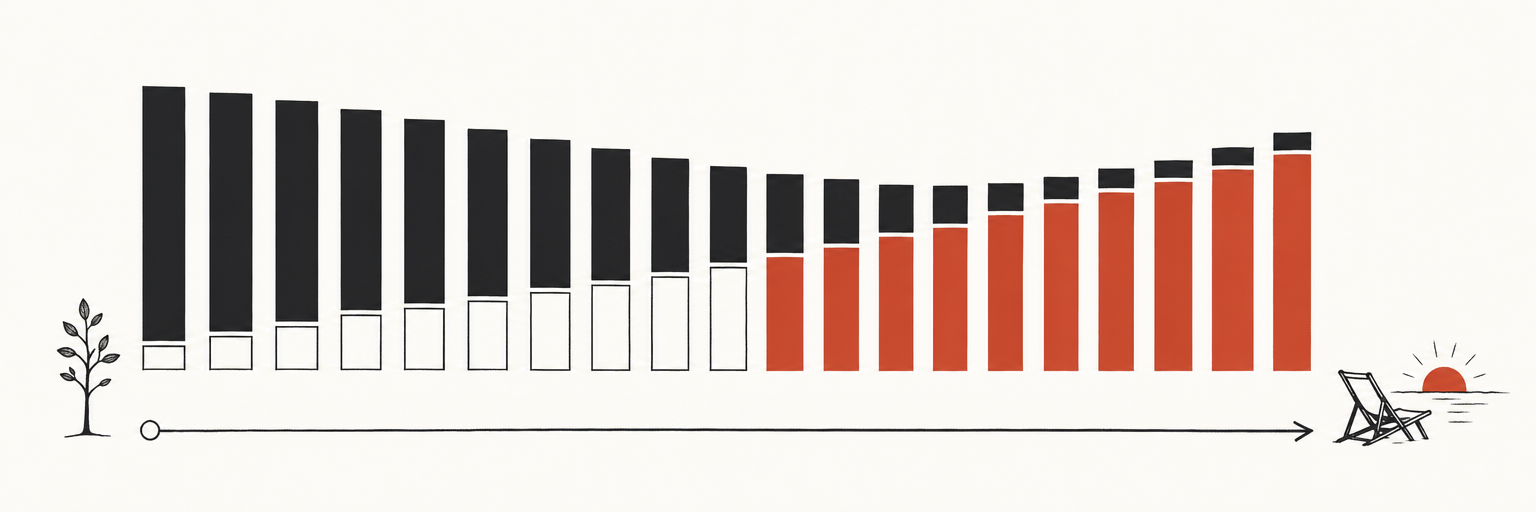
A target-date fund (sometimes called a lifecycle fund) is a fund-of-funds designed to be your entire retirement portfolio in a single investment. You pick a fund named after the year you expect to retire — Vanguard Target Retirement 2055, Fidelity Freedom Index 2060 — and it manages your asset allocation automatically from now until and through retirement. Target-date funds held more than $5.2 trillion in assets at the end of 2025, up 21% in a single year, making them the dominant investment vehicle in employer-sponsored retirement plans (Sway Research / PLANADVISER, 2026).
How the glide path works
The defining feature of a target-date fund is its glide path — the automatic, predetermined shift from higher-risk (mostly stocks) to lower-risk (mostly bonds) holdings as you approach and enter retirement. You do nothing. The fund rebalances itself on schedule.
A typical glide path progression:
| Years to target date | Approximate stock allocation | Approximate bond allocation |
|---|---|---|
| 35+ years out | 90–95% | 5–10% |
| 20 years out | 80–85% | 15–20% |
| 10 years out | 65–75% | 25–35% |
| At target date | 45–55% | 45–55% |
| 10 years past target date | 25–35% | 65–75% |
The logic: with decades until retirement, you can absorb a 40% market drop because you have time to recover. Five years from retirement, a 40% crash could permanently impair your income. The glide path manages this transition for you.
What’s inside a target-date fund
Most low-cost target-date funds hold a handful of index funds covering four broad categories:
- US total stock market — all publicly traded US companies (~3,700+ stocks)
- International stocks — developed and emerging markets outside the US
- US bonds — government and investment-grade corporate bonds
- International bonds — non-US sovereign and corporate debt
A Vanguard Target Retirement 2055 fund, for instance, holds four underlying Vanguard index funds and rebalances them automatically. Fidelity Freedom Index funds follow the same structure. The simplicity is the point: one decision, decades of automatic management.
”To” vs “through” retirement — a critical distinction
Not all target-date funds treat the target date the same way. This distinction matters enormously for investors who plan to keep the fund throughout a 20–30 year retirement.
“To” retirement funds reach their most conservative allocation on or near the target date and stop changing. If you plan to withdraw most assets at retirement and move them to an annuity or cash, a “to” fund may fit.
“Through” retirement funds continue shifting more conservative for 10–20 years after the target date. They assume you will stay invested and draw down gradually over a decades-long retirement. This approach accounts for longevity risk — the chance you outlive your savings.
Fidelity and Vanguard funds are “through” funds. Vanguard’s glide path progresses from roughly 90% equity during peak accumulation years to approximately 50% equities at the target date, then continues shifting to around 30% equities roughly seven years after retirement. Fidelity Freedom Index funds follow a similar trajectory, settling at 32% equities approximately 18 years into retirement.
Both approaches are reasonable. Most younger investors planning for a long retirement are better served by “through” funds.
Provider comparison: expense ratios and approach
Two funds with the same target year can be very different products. Expense ratios vary by a factor of eight or more across providers, and that difference compounds into tens of thousands of dollars over a 30-year horizon.
| Fund family | Expense ratio | Glide path type | Notes |
|---|---|---|---|
| Vanguard Target Retirement | 0.08% | Through | All-index; largest TDF manager ($1.79T AUM) |
| Schwab Target Date Index | 0.08% | Through | All-index; comparable to Vanguard |
| Fidelity Freedom Index | 0.12% | Through | All-index; avoid non-index Freedom Funds |
| T. Rowe Price Retirement | 0.49–0.64% | Through | Actively managed; higher cost |
| Industry average (401k) | ~0.41% | Varies | Per Morningstar; older plans skew higher |
The expense ratio difference is not trivial. At a 0.08% fee vs. 0.50% fee on a $100,000 portfolio growing at 8% annually, you keep roughly $38,000 more over 30 years — just from the fee difference. Always check your 401k plan’s specific offerings; some older plans offer only higher-cost versions.
When target-date funds make sense
Target-date funds are particularly well-suited for:
- 401k investors who want simplicity — one fund, one decision, automatic management
- Investors prone to emotional selling — the fund rebalances so you don’t have to react to market swings
- Those without strong investment preferences — a low-cost target-date fund beats a self-managed portfolio that gets abandoned or poorly maintained
They are less ideal for:
- Investors with multiple accounts — a target-date fund in your 401k and a target-date fund in your IRA may double-count bond exposure, leaving you more conservative than intended
- High earners with large taxable brokerage accounts — target-date funds can distribute capital gains, creating a tax drag; in taxable accounts, a three-fund portfolio often works better
- Investors wanting precise control — if you want to tilt toward small-cap value or exclude certain sectors, a target-date fund won’t let you
One warning: the same year does not mean the same fund
A 2050 fund at Vanguard and a 2050 fund at T. Rowe Price may hold very different stock-to-bond ratios and charge dramatically different fees. Per the U.S. Department of Labor’s guidance to plan fiduciaries, investors cannot assume two target-date funds with the same year are equivalent. Always verify three things before selecting:
- The expense ratio (target below 0.15%; red flag above 0.40%)
- The current stock/bond split (check whether it matches your actual risk tolerance)
- Whether the glide path is “to” or “through” retirement
Common mistakes
Picking the wrong year. If you plan to retire at 60 but pick a 2065 fund, you’ll be too aggressive near retirement. Match the fund year to your expected retirement year, not your birth year.
Holding multiple target-date funds. One is the entire portfolio — adding a second creates unintended overlap and often an allocation mismatch.
Ignoring the expense ratio in older 401k plans. Many company plans still offer target-date funds from the 1990s-era fund families with 0.50–0.80% expense ratios. If your plan has this, lobby for better options — or use the lowest-cost equity index fund available and manage the allocation yourself.
Assuming “set and forget” means no review. You should still verify once a year that you’re in the right fund year and that the expense ratio is competitive.
Concrete next action
Log into your 401k or IRA. Find any target-date funds available. Sort by expense ratio. If you can access a Vanguard, Schwab, or Fidelity Index target-date fund under 0.15%, select the one whose year matches your expected retirement. That single decision handles everything else — asset allocation, rebalancing, the glide toward bonds — automatically.