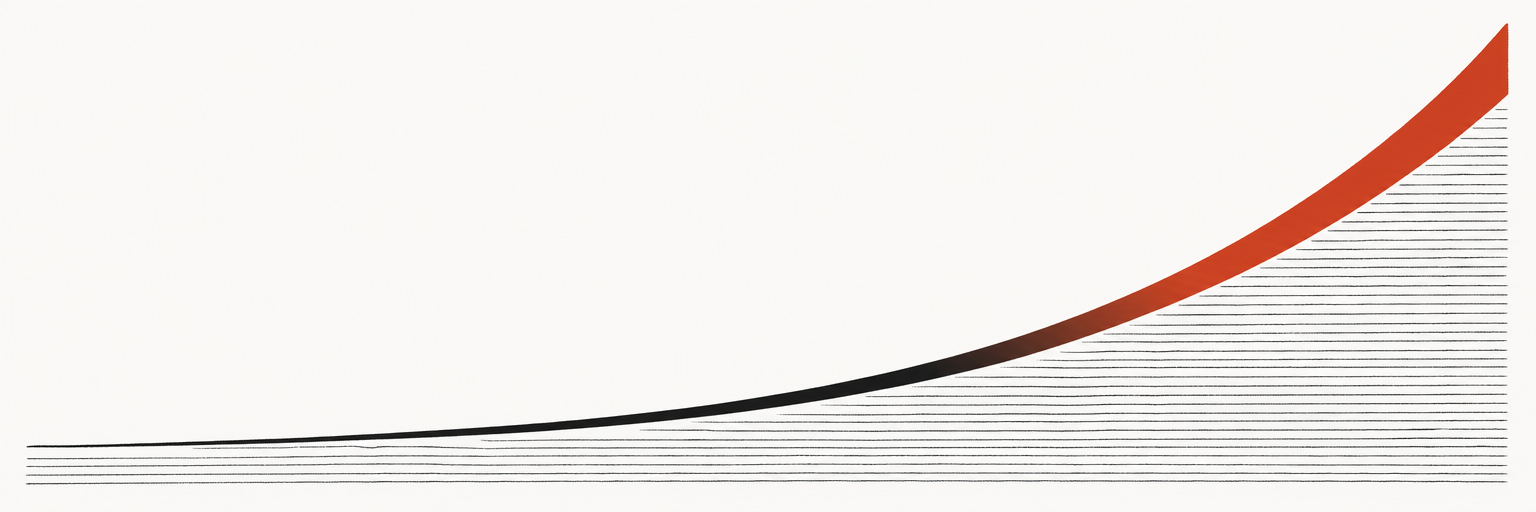
Compound interest means every dollar your money earns immediately starts earning its own returns. Your original principal generates gains, those gains become part of the base, and the entire growing sum earns the next period’s return. The result is not a straight line — it is a curve that tilts sharply upward the longer you wait. Over a 30-year horizon, the difference between simple interest and compound interest on a $10,000 investment at 7% per year is more than $46,000 in additional wealth. That gap is not from investing more money. It is purely the structure of compounding working across time.
Simple interest vs. compound interest
With simple interest, you earn returns only on your original principal, every period, forever. With compound interest, each period’s return is added to the base, so the following period’s return is larger.
Starting with $10,000 at 7% annually:
| Year | Simple interest balance | Compound interest balance |
|---|---|---|
| 1 | $10,700 | $10,700 |
| 5 | $13,500 | $14,026 |
| 10 | $17,000 | $19,672 |
| 20 | $24,000 | $38,697 |
| 30 | $31,000 | $76,123 |
By year 30, compound growth produces $76,123 against simple interest’s $31,000. The extra $45,000 came from no additional investment — only from gains compounding on prior gains.
The formula
The compound interest formula:
A = P × (1 + r/n)^(n × t)
Where:
- A = final amount
- P = principal (starting amount)
- r = annual interest rate (as a decimal)
- n = number of compounding periods per year
- t = time in years
Compounding frequency matters at the margins. Daily compounding produces slightly more than annual compounding at the same stated rate — but the difference is small compared to the impact of time and the rate itself.
What $10,000 becomes across decades
Using a 7% annual return — a conservative proxy for a diversified equity portfolio, since the S&P 500 has delivered roughly 10% nominal and about 7.4% inflation-adjusted annually over the past 30 years (source: macrotrends.net) — with no additional contributions:
| Years invested | Balance |
|---|---|
| 10 | $19,672 |
| 20 | $38,697 |
| 30 | $76,123 |
| 40 | $149,745 |
The pattern is striking: the second 10 years add roughly $19,000, the third 10 years add $37,000, and the fourth 10 years add $73,000. Each decade nearly doubles the total gain of the prior decade. This is the exponential curve in practice.
At the S&P 500’s nominal historical average of approximately 10% annually, that same $10,000 grows to $67,275 over 30 years — and to $174,494 over 40 years. The difference between starting at 25 versus 35 is not 10 years of returns; it is roughly $100,000 in final wealth on a single $10,000 investment.
The Rule of 72
The Rule of 72 is a mental shortcut for estimating how long it takes to double your money. Divide 72 by your annual rate of return:
| Annual return | Years to double |
|---|---|
| 4% (high-yield savings) | 18 years |
| 6% (conservative portfolio) | 12 years |
| 7% (moderate portfolio) | 10.3 years |
| 10% (S&P 500 historical average) | 7.2 years |
| 20% (credit card APR) | 3.6 years |
The last row is a warning, not an opportunity. The same math that builds wealth in investment accounts destroys it in debt accounts — and credit cards typically compound daily, which is more aggressive than annual compounding at the stated rate.
How inflation compounds against you
Compounding is not only a tool for building wealth. Inflation uses the same mechanism to erode it. The U.S. Federal Reserve targets 2% annual inflation; the 30-year average CPI inflation rate has been closer to 2.5–3%.
At 3% annual inflation, $10,000 today has the purchasing power of roughly $4,120 in 30 years — meaning you need $24,270 in future dollars just to buy what $10,000 buys today (source: BLS CPI calculator). Your investments do not just need to grow. They need to grow faster than inflation to produce real gains.
This is why keeping a large portion of long-term savings in cash or low-yield accounts is itself a compounding risk: each year, inflation compounds the erosion of purchasing power on that idle money.
Where compounding works for and against you
In your favor:
- Equity index funds and ETFs — market gains compound annually as prices rise and dividends are reinvested
- Dividend reinvestment (DRIP) — dividends automatically purchase additional shares, which pay their own future dividends
- 401(k) and IRA growth over decades, where tax deferral or tax-free status adds another layer of advantage
- High-yield savings accounts and certificates of deposit, which typically compound daily or monthly
Against you:
- Credit card balances — the average APR in 2026 exceeds 20%, compounding daily; a $5,000 balance with minimum payments can grow to over $8,000 before it’s paid off
- Student loans that accrue interest during school before repayment begins
- Buy-now-pay-later financing with deferred interest clauses that capitalize retroactively
- Inflation on cash savings — every year you delay investing is a year compounding works against your purchasing power
Common mistakes
Waiting for a “better time” to start. The cost of waiting one year at 7% on a $10,000 investment is roughly $700 in year one — but because that $700 would have compounded for the remaining years, the real cost of waiting a decade at the start is often $20,000–$30,000 in foregone final wealth.
Withdrawing early and breaking the chain. Every time you pull money out of a compounding account, you remove not just the dollars you withdraw but all the future compounding those dollars would have generated. A $5,000 withdrawal at age 35 can cost more than $40,000 by retirement at 65 (at 7%).
Focusing only on returns, ignoring fees. An expense ratio of 1% versus 0.05% sounds trivial. Over 30 years on a $50,000 portfolio, a 1% annual drag reduces your final balance by approximately $80,000 compared to a low-cost index fund. Fees compound too.
Using APR and APY interchangeably. APR (annual percentage rate) does not account for compounding within the year. APY (annual percentage yield) does. When comparing savings accounts or loans, always use APY for an apples-to-apples comparison.
Getting started
The single most valuable action is opening a tax-advantaged account — a 401(k) through your employer, or an IRA you open yourself — and investing as early as possible, even in small amounts. Time is the input compound interest values most.
A straightforward starting approach: contribute enough to your 401(k) to capture any employer match (that is an immediate 50–100% return on those dollars), then open a Roth IRA and contribute up to the $7,500 annual limit for 2026. Inside those accounts, low-cost index funds automatically reinvest dividends and let compounding work without requiring ongoing decisions.
The math rewards consistency over perfection. Starting with $200 per month at age 25, earning 7% annually, produces approximately $525,000 by age 65. Waiting until 35 to start the same habit produces about $243,000 — less than half, for the same monthly investment over the same working life. The variable that changed was not the amount invested. It was the years of compounding.