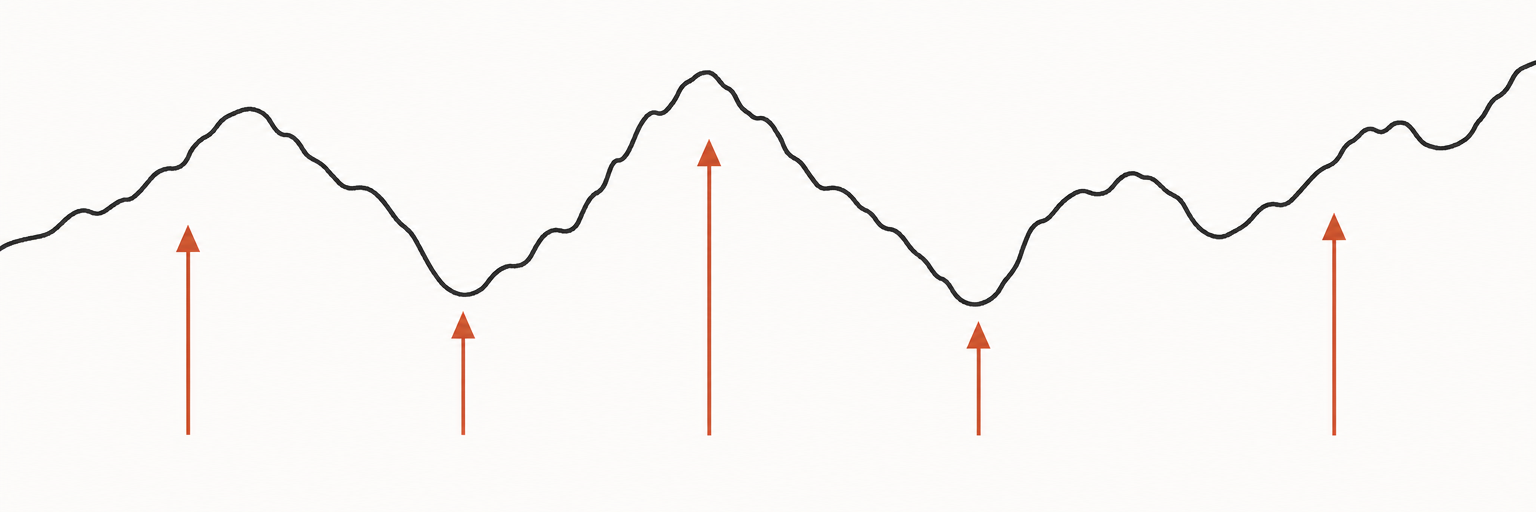
Dollar-cost averaging (DCA) is the practice of investing a fixed dollar amount at regular intervals — monthly, biweekly, or with every paycheck — regardless of whether the market is up, down, or flat. You don’t try to find the optimal moment to buy. You invest on schedule and let the market’s natural fluctuations work in your favor mechanically.
The result: the same fixed dollar amount automatically buys more shares when prices fall and fewer shares when prices rise. Over time, this tends to lower your average cost per share below the simple average share price over the same period.
How it works: a concrete example
Suppose you invest $500 every month into a total market index fund.
| Month | Share price | Shares purchased | Cumulative shares | Cumulative invested |
|---|---|---|---|---|
| January | $100.00 | 5.00 | 5.00 | $500 |
| February | $80.00 | 6.25 | 11.25 | $1,000 |
| March | $60.00 | 8.33 | 19.58 | $1,500 |
| April | $75.00 | 6.67 | 26.25 | $2,000 |
| May | $90.00 | 5.56 | 31.81 | $2,500 |
| June | $100.00 | 5.00 | 36.81 | $3,000 |
After six months you’ve invested $3,000. At $100/share (back to the starting price), your 36.81 shares are worth $3,681 — a gain of $681 even though the price ended exactly where it started. The average cost per share you paid was approximately $81.51, well below the $100 starting price, because the larger purchases happened at lower prices.
This is the mechanical advantage of DCA: it forces discipline — buy more when things are cheap — without requiring you to feel confident or make a prediction.
DCA vs. lump-sum investing
Vanguard research (Finlay & Zorn, 2023) compared lump-sum investing against dollar-cost averaging using global market data from 1976–2022. The findings were clear: lump-sum investing outperformed DCA in approximately 68% of historical periods for a 60/40 portfolio, and between 61.6% and 73.7% of the time depending on portfolio composition.
The reason is straightforward: markets trend upward over time. Money sitting uninvested, waiting to be deployed gradually, misses market exposure. The longer you stretch out the DCA window, the more performance you sacrifice on average.
| Strategy | Outperforms (historical %) | Best use case |
|---|---|---|
| Lump-sum invest immediately | ~68% of periods | Large windfall (inheritance, bonus, asset sale) |
| Dollar-cost averaging | ~32% of periods | Regular income investors; volatile markets; psychological comfort |
However, this comparison only applies when you have a large sum available to invest all at once. Most investors aren’t choosing between DCA and a lump sum — they’re earning a paycheck and deciding how much to invest from each one. For regular income investors, DCA is not a suboptimal strategy. It is the only practical strategy. The realistic alternative to DCA from a paycheck isn’t a lump sum — it’s waiting, which performs worse.
The psychological case for DCA
Even for investors who receive a windfall, Vanguard’s own research acknowledges that DCA wins on a different metric: investor behavior. Lump-sum investors who deploy everything at once before a sharp market drop often panic-sell, locking in losses. DCA investors who spread out purchases over 6–12 months tend to stay the course because they haven’t fully committed at a single high point.
A strategy that earns 15% less but that you actually stick with beats an optimal strategy you abandon during a 30% drawdown. The value of DCA is partly mathematical and substantially psychological.
DCA already works automatically in most 401(k)s
If you contribute to a 401(k) through payroll deductions, you’re already dollar-cost averaging. Every paycheck, a fixed dollar amount goes into your retirement account before you can spend it. You buy whatever the market offers that day — more shares in a downturn, fewer at a peak. This structural feature is one of the primary reasons 401(k) investors build wealth steadily over decades: the mechanism forces the behavior.
The real cost of stopping contributions during downturns
The investors who paused 401(k) contributions during the 2008–2009 financial crisis missed the recovery. The S&P 500 fell approximately 57% from peak to trough — and then returned roughly 400% over the next decade. DCA investors who kept buying through 2008 and 2009 purchased shares at dramatically reduced prices. Those purchases were their most valuable.
The same pattern appeared in March 2020: the S&P 500 dropped 34% in five weeks and recovered to new all-time highs within six months. Investors who stopped contributing during the panic missed the entire rebound.
How to set up DCA
- Open a brokerage or retirement account — 401(k), Roth IRA, or taxable brokerage
- Choose a low-cost index fund — look for expense ratios below 0.10%
- Set a fixed monthly transfer — even $50 or $100; the consistency matters more than the amount
- Enable automatic investing — most brokerages let you schedule automatic fund purchases on a set date
- Don’t stop during downturns — those months are when DCA provides its largest mechanical advantage
What DCA does not protect you from
DCA reduces the risk of investing a large amount at a peak right before a sustained decline. It does not protect against prolonged bear markets. If you invest $500/month and the market falls 40% and stays depressed for three years, your portfolio will be in a loss position for that period.
For long-term investors with a horizon of 10+ years, this is manageable — every sustained market decline in US history has eventually reversed. But DCA is not a shield against volatility or short-term losses. It’s a discipline system for building a position steadily over time, and it works precisely because it keeps you invested through conditions that otherwise cause investors to stop.
Common mistakes
Investing in actively managed funds instead of index funds. DCA’s mathematical advantage erodes if the underlying fund has a 1% expense ratio dragging returns each year. Pair DCA with low-cost index funds.
Stopping during market drops. This is the most common and costly mistake. The months you most want to stop are the months DCA is most valuable.
Using DCA as an excuse to delay investing. If you have $10,000 sitting in a low-yield savings account that you plan to invest “gradually over 12 months,” you’ve chosen the historically inferior approach. The Vanguard data favors deploying lump sums immediately. DCA is for regular income, not for procrastination.
Spreading contributions across too many funds. DCA works best with a simple, consistent allocation — one or two index funds. Complexity creates decision fatigue that leads to stopping.
The next action
If you have a 401(k) at work, log in and confirm you’re contributing at least enough to capture the full employer match. If you have a Roth IRA, set up a monthly automatic transfer and enable automatic investment into a total market index fund. Start now with whatever amount you can afford — the schedule and consistency matter far more than the starting amount.