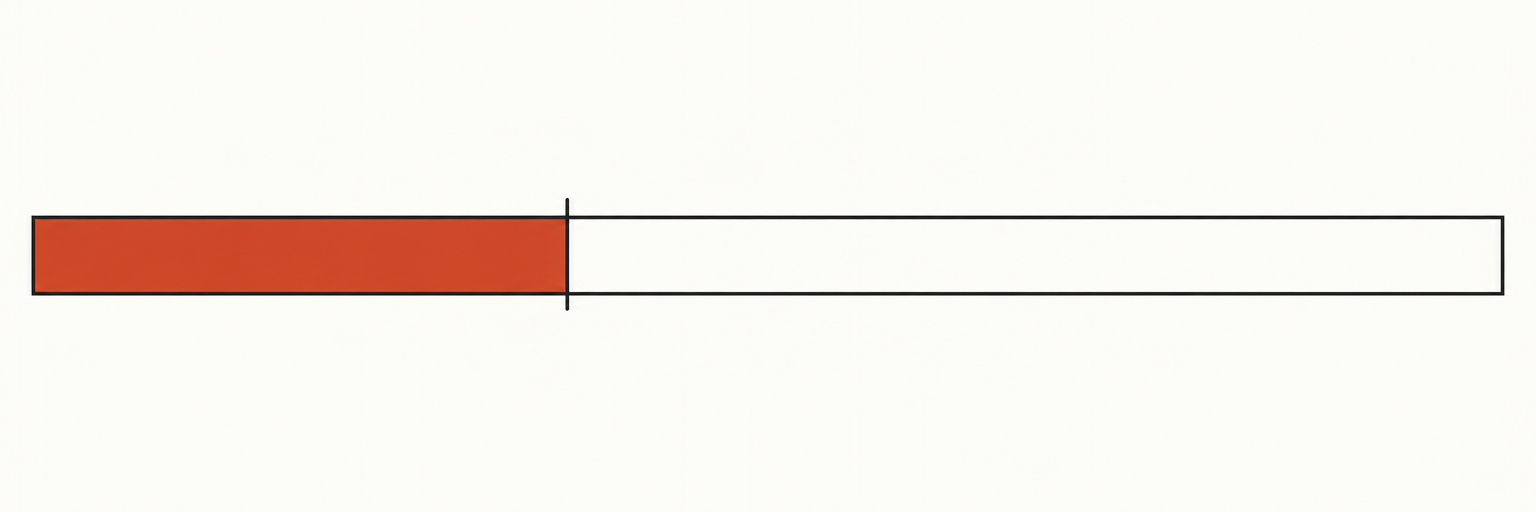
Keep rent at or below 30% of gross (pre-tax) monthly income. That is the official U.S. benchmark — the U.S. Department of Housing and Urban Development (HUD) defines households spending more than 30% of gross income on housing as cost-burdened. In practice, 30% of take-home pay is a more useful ceiling for planning your actual monthly budget.
The 30% rule: origin and definition
The 30% threshold entered U.S. housing policy in the 1981 reauthorization of the Housing Act, updating an earlier 25% standard. HUD uses it as the definition of housing affordability: households spending more than 30% of gross income on housing are cost-burdened; those spending more than 50% are severely cost-burdened.
According to the Census Bureau’s 2023 American Housing Survey, approximately 50% of U.S. renters are cost-burdened — paying more than 30% of gross income on rent. In high-cost metro areas, that share rises substantially. The National Low Income Housing Coalition’s 2024 Out of Reach report found that in no U.S. state can a full-time minimum wage worker afford a one-bedroom apartment at fair market rent.
This does not mean the rule is wrong. It means housing markets in many cities have moved out of reach of the rule — making the decision about how much to spend on rent more consequential than it was decades ago.
The 30% rule applied to gross income
Gross income means before taxes, health insurance premiums, 401(k) contributions, or any other deductions.
| Annual gross income | Monthly gross | 30% rent ceiling |
|---|---|---|
| $35,000 | $2,917 | $875 |
| $50,000 | $4,167 | $1,250 |
| $65,000 | $5,417 | $1,625 |
| $80,000 | $6,667 | $2,000 |
| $100,000 | $8,333 | $2,500 |
| $130,000 | $10,833 | $3,250 |
In major rental markets, available inventory at or below these thresholds is scarce for the lower income levels. The median asking rent in the United States reached approximately $1,600–$1,700/month in 2024, according to Apartment List’s national rent data — a figure that implies a required income of $64,000–$68,000 to meet the 30% gross rule.
Why take-home pay is more useful than gross
The 30%-of-gross rule was useful when marginal tax rates and benefits structures were simpler. Today, 30–35% of net (take-home) pay is the practical ceiling that aligns the rent limit with money you can actually spend.
Someone earning $70,000 gross in a moderate-tax state might take home $52,000 after federal income taxes, FICA, state taxes, and health insurance premiums. The difference:
- 30% of gross = $1,750/month ceiling
- 30% of net = $1,300/month ceiling
These are meaningfully different budgets. Using take-home pay prevents the common mistake of calculating affordability against a number that doesn’t reflect your actual cash flow.
City-level rent vs. income comparison
| Metro area | Median 1BR rent (2024) | Income needed at 30% gross | Median renter income |
|---|---|---|---|
| New York City | $2,900 | $116,000 | ~$62,000 |
| San Francisco | $2,800 | $112,000 | ~$78,000 |
| Austin, TX | $1,600 | $64,000 | ~$58,000 |
| Chicago, IL | $1,700 | $68,000 | ~$54,000 |
| Phoenix, AZ | $1,400 | $56,000 | ~$52,000 |
| Columbus, OH | $1,100 | $44,000 | ~$48,000 |
| Memphis, TN | $950 | $38,000 | ~$40,000 |
In New York and San Francisco, median renter income falls $38,000–$50,000 short of what the 30% rule requires to afford median rent. This is not an individual budgeting problem — it is a structural affordability gap that requires either higher income, roommates, or accepting cost-burdened status with a clear understanding of the trade-offs.
When breaking the 30% rule makes sense
Going above 30% can be justified when:
- You are early in your career in a high-opportunity, high-wage city where compensation growth is realistic
- You have no car, no debt, and very low transportation costs — reducing overall expense burden
- You are renting temporarily with a clear plan to move or lower costs within 12–18 months
- Your employer provides significant benefits that reduce other costs (meals, transit, health insurance)
It becomes a structural problem when:
- Rent leaves less than 20% of take-home pay available for savings
- You carry high-interest debt that is not being meaningfully paid down
- You have no emergency fund and one unexpected expense would require credit card debt
The real test: what’s left after rent
Subtract rent from your monthly take-home pay. Then subtract all other necessities: groceries, utilities, transportation, insurance, minimum debt payments. What remains is your margin — available for savings, discretionary spending, and financial goals.
If margin is below 20% of take-home pay, rent is too high relative to your income — regardless of what percentage rent represents on its own.
Example:
- Take-home: $4,200/month
- Rent: $1,600 (38% of take-home)
- Groceries: $400, utilities: $150, transportation: $300, insurance: $120, debt minimums: $250
- Total necessities: $2,820
- Remaining: $1,380 (33% of take-home)
In this case, rent is above 30% of take-home, but the remaining margin is still workable — over $1,000/month for savings, debt payoff, and discretionary spending. The percentage alone is less important than the absolute margin.
Options if rent exceeds your target
- Add a roommate: Splitting a $2,000 two-bedroom reduces each person’s rent to $1,000 — often below what a one-bedroom in the same neighborhood would cost
- Extend your commute: Suburban or secondary-neighborhood apartments are frequently $300–$600/month cheaper than urban core equivalents
- Negotiate lease renewal: Landlords prefer reliable tenants over vacancy; a 5–10% reduction request at renewal is reasonable, especially if you’ve been on time with rent
- Increase income: In high-cost markets, housing cost is often the constraint — a salary increase or side income has a larger impact on affordability than cutting other expenses
Common mistakes
Calculating affordability against gross income but budgeting with net income. Your rent must be paid from take-home pay. Use the same base when calculating the ratio.
Ignoring utilities and renter’s insurance. Total housing cost includes utilities ($100–$300/month) and renter’s insurance ($15–$30/month). A $1,500 rent apartment with $250 in utilities is a $1,750 housing cost — apply the 30% rule to the total.
Stretching rent to get more space “just in case.” Renting up for a hypothetical roommate or anticipated income increase is one of the most common ways people lock themselves into an unaffordable situation. Budget for what you earn now, not what you might earn.
Treating rent as fixed and everything else as variable. Rent is often the largest and most fixed expense in a budget. If rent is consuming too much income, it is worth the disruption of moving — the monthly savings compound over months and years.
Next action
Calculate your rent as a percentage of your gross monthly income and again as a percentage of your take-home pay. Then run the margin calculation: take-home minus rent minus all other necessities. If the resulting margin is below 20% of take-home, you have a housing cost problem worth addressing — either through income growth, roommates, or a move to a lower-cost apartment.