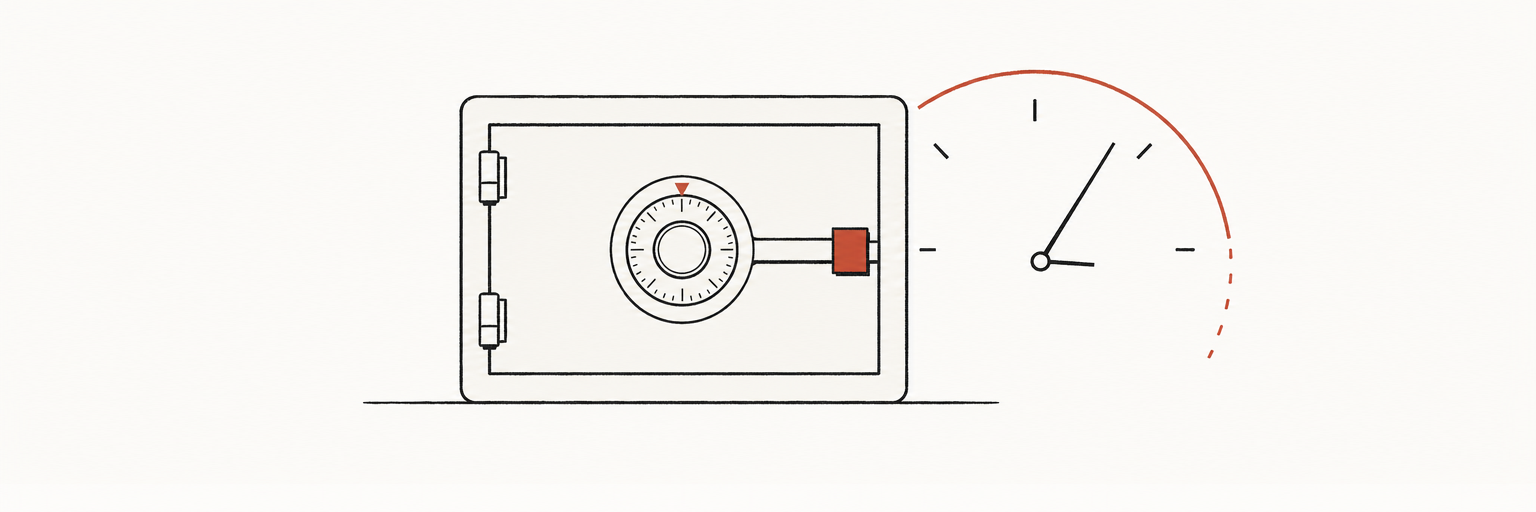
A certificate of deposit (CD) is a time-locked savings account offered by banks and credit unions. You agree to leave a specific amount of money deposited for a set period — the “term” — in exchange for a fixed, guaranteed interest rate. At the end of the term (the maturity date), you collect your principal plus interest. If you need the money before the term ends, you pay an early withdrawal penalty — typically 3 to 12 months of interest depending on the term and institution.
The core trade-off: a CD gives up flexibility in exchange for a rate that cannot be cut during the term. That certainty makes CDs useful when interest rates are falling or when you know exactly when you will need the money.
How CDs work, step by step
- Choose a term — typically 3, 6, 12, 24, or 60 months
- Deposit your funds (minimum is often $500–$1,000; some banks require more)
- The bank locks in the interest rate for the full term
- At maturity, you receive principal + all interest earned
- Most CDs auto-renew at maturity — if you do nothing, the bank rolls it into a new CD at the current rate. Most banks give you a brief grace period (7–10 days) to withdraw or change terms without penalty.
Current CD rates (April 2026)
According to FDIC data, the national averages are being pulled down by major banks paying near-zero. Online banks and credit unions offer rates 3–4x higher.
| Term | National average APY | Best available APY |
|---|---|---|
| 3-month | 1.25% | ~4.5–5.0% |
| 6-month | 1.44% | ~4.5–5.0% |
| 12-month | 1.53% | ~4.25–4.75% |
| 24-month | 1.51% | ~4.0–4.5% |
| 60-month | 1.35% | ~3.75–4.25% |
Note that in April 2026, the rate curve for CDs is relatively flat — a 5-year CD does not pay dramatically more than a 1-year CD. This makes shorter-term CDs particularly attractive: you earn nearly the same rate with far less commitment.
CD vs. high-yield savings account
The choice between a CD and a HYSA comes down to two questions: (1) Do you know when you’ll need the money? (2) Do you think rates will rise or fall?
| CD | High-yield savings account | |
|---|---|---|
| Rate | Fixed — guaranteed for the full term | Variable — moves with Federal Reserve |
| Access | Locked — penalty for early withdrawal | Flexible — withdraw anytime |
| Rate risk | None once locked | Rate can fall with Fed cuts |
| Best use | Money with a known future date | Emergency fund, ongoing savings |
| FDIC insured | Yes, up to $250,000 | Yes, up to $250,000 |
| Minimum | Often $500–$1,000 | Often $0 |
When a CD wins: If the Federal Reserve is cutting interest rates, locking in today’s higher rate through a CD protects you. While HYSA rates will fall when the Fed cuts, your CD rate stays fixed.
When a HYSA wins: If rates are rising, or if you are uncertain when you’ll need the money, the flexibility of a HYSA is more valuable than the rate lock.
CD laddering: keep some liquidity while locking in rates
A CD ladder divides your savings across multiple CDs with staggered maturity dates. You earn fixed rates on the bulk of your money while always having a CD maturing soon.
Example: $20,000 split across four CDs:
| CD | Amount | Term | Matures |
|---|---|---|---|
| CD 1 | $5,000 | 3-month | July 2026 |
| CD 2 | $5,000 | 6-month | October 2026 |
| CD 3 | $5,000 | 9-month | January 2027 |
| CD 4 | $5,000 | 12-month | April 2027 |
As each CD matures, you renew it into a 12-month CD. After one full cycle, you will have a CD maturing every three months — giving you a regular liquidity window while earning close to the top 12-month rate on all four CDs.
Laddering works especially well when you are uncertain whether rates will rise or fall. You are not fully committed to any single rate environment.
Early withdrawal penalties: the real cost
Federal law requires banks to charge a minimum penalty for early withdrawal from CDs, but there is no federal maximum — banks set their own policies. As a reference point, Wells Fargo’s structure as of 2026:
| CD term | Early withdrawal penalty |
|---|---|
| Under 90 days | 1 month of interest |
| 90 days – 12 months | 3 months of interest |
| 12–24 months | 6 months of interest |
| Over 24 months | 12 months of interest |
Breaking a CD early is not catastrophic — you lose some interest, not your principal — but the penalty can eliminate months of earnings. Always verify the exact penalty structure before committing. Some banks charge flat-fee penalties that are even more punishing on short-term CDs.
No-penalty CDs: flexibility without the risk
A no-penalty CD (also called a liquid CD or breakable CD) lets you withdraw early without paying a penalty — typically after an initial holding period of 6–7 days. In exchange, the rate is usually 0.25–0.75 percentage points lower than a comparable standard CD.
No-penalty CDs are useful if you want the psychological comfort of a fixed rate but are not confident you can leave the money untouched. They function somewhat like a HYSA with a fixed rate — accessible, but with a rate that cannot be cut mid-term.
What to verify before opening a CD
Per FDIC guidance:
- Confirm FDIC insurance at fdic.gov/bankfind
- Read the exact early withdrawal penalty — it varies widely and must be disclosed before you open the account
- Understand the auto-renewal policy — most CDs roll into a new CD automatically at maturity; mark your calendar for the grace period
- Check whether the rate is fixed or variable — almost all standard CDs are fixed; “market-linked” or “index-linked” CDs are different products with different risks
- Verify the minimum deposit — falling below the minimum after opening can reduce your rate
Common mistakes
Putting an emergency fund in a CD. If your car breaks down or you lose income, you will either pay the early withdrawal penalty to access your savings or take on debt while your money sits locked. Emergency funds belong in a HYSA, not a CD.
Ignoring auto-renewal. A CD that renews automatically at maturity locks you in at whatever today’s prevailing rate is — which might be higher or lower than your original rate. Set a calendar reminder for 3 days before maturity to review and decide.
Chasing the highest rate at an unverified bank. Some online banks offering aggressively high rates are not FDIC members. Always confirm before depositing.
Opening one large CD instead of laddering. A single large CD with a distant maturity date concentrates your rate risk and ties up all your cash. Laddering 3–4 smaller CDs dramatically reduces both risks.
Next step
If you have cash that you will not need for 6–12 months and you want a guaranteed rate, open a 6-month or 12-month CD at an online bank today. Compare rates using Bankrate’s CD rate table or the FDIC’s BankFind tool. If you are unsure when you will need the money, start with a HYSA and move to CDs once your emergency fund is fully funded.