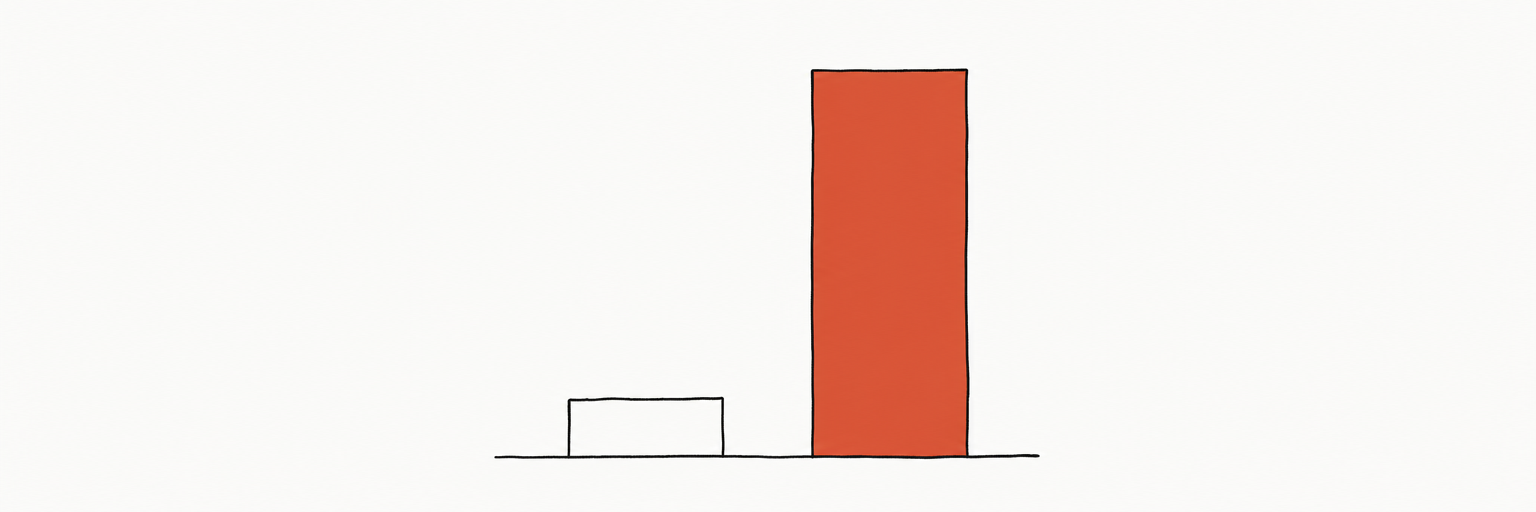
A high-yield savings account (HYSA) is a deposit account at a bank or credit union that pays a substantially higher interest rate than what you’d earn at a traditional brick-and-mortar bank. As of April 2026, the national average for savings accounts is 0.38% APY according to FDIC data, while the top high-yield accounts pay 4–5% APY — more than 10x the average. The accounts are federally insured and your money is accessible anytime, making them one of the few places where you can earn meaningfully more with zero additional risk.
How much more interest you actually earn
The gap between a standard savings account and a high-yield account is not marginal — it compounds into hundreds or thousands of dollars per year depending on your balance.
| Starting balance | Standard savings (0.38% APY) | High-yield savings (4.5% APY) | Annual difference |
|---|---|---|---|
| $5,000 | $19 | $225 | +$206 |
| $10,000 | $38 | $450 | +$412 |
| $20,000 | $76 | $900 | +$824 |
| $50,000 | $190 | $2,250 | +$2,060 |
On a $10,000 emergency fund, the difference between a 0.38% account and a 4.5% account is $412 in the first year. That money requires no extra work — just parking your cash in the right place.
Why online banks pay so much more
Most high-yield savings accounts are offered by online-only banks — institutions like Ally, Marcus by Goldman Sachs, Synchrony, and Discover that have no physical branch network. Without the overhead of thousands of tellers, ATMs, and real estate, online banks can return those savings to depositors in the form of higher rates.
Traditional banks like Bank of America and Wells Fargo rely on the inertia of existing customers and the convenience premium of physical branches to keep rates low. The FDIC’s April 2026 data confirms this: the national average of 0.38% is pulled down almost entirely by large traditional banks sitting at 0.01–0.10% APY on basic savings.
Credit unions — member-owned cooperatives — also frequently offer competitive rates and are insured by the NCUA (National Credit Union Administration) up to the same $250,000 per member limit.
The safety picture: FDIC and NCUA insurance
A high APY at an FDIC-insured bank carries exactly the same deposit safety as a low APY at your local bank. FDIC insurance covers up to $250,000 per depositor, per institution, per ownership category. If the bank fails, the FDIC guarantees your deposits — this coverage has never failed a depositor since the FDIC was created in 1933.
Before depositing, verify the bank’s status at fdic.gov/bankfind. Do not rely on a bank’s marketing claims alone.
Variable rate: the key risk to understand
High-yield savings rates are variable — they move with the Federal Reserve’s benchmark interest rate. When the Fed cuts rates, HYSA rates fall, often within two to four weeks of the Fed’s decision. When the Fed raises rates, HYSA rates rise.
This is not a hidden risk — it is simply how these accounts work. The rate you earn today is not guaranteed to persist. If you need a guaranteed rate for a fixed period, a certificate of deposit (CD) is the alternative worth considering.
Regulation D withdrawal limits
Historically, federal Regulation D capped savings account withdrawals at 6 per month. The Federal Reserve suspended this rule in April 2020 and has not reinstated it. However, many banks still impose their own 6-transaction monthly limit by policy, and some charge excess transaction fees. Check the account terms before assuming unlimited withdrawals.
ATM and in-person withdrawals have generally never been subject to these limits.
What to compare when choosing an account
Not all high-yield accounts are equal. Before opening one, check each of the following:
- APY: The annualized rate including compounding effects. Quoted as APY, not APR.
- Minimum balance to earn the APY: Some accounts pay the advertised rate only on balances above $1,000 or $5,000. Others pay it from $0.01.
- Monthly fees: The best HYSAs charge no monthly maintenance fees. Any fee that exceeds your interest earned defeats the purpose.
- Withdrawal limits: Confirm whether the bank imposes its own transaction caps beyond what federal rules require.
- Account linkage requirements: Some banks require you to open a checking account with them to access the HYSA rate. This is not necessarily bad, but it is a condition worth knowing.
- Compounding frequency: Daily compounding slightly outperforms monthly compounding over time, though the difference is modest.
Who should open a high-yield savings account
A HYSA is the appropriate account for any cash you want to keep liquid while earning meaningful interest:
- Emergency fund (3–6 months of essential expenses): The most important use case. Your emergency fund must be accessible instantly — a CD locks it up, and investing it introduces risk. A HYSA gives you liquidity and a real return.
- Down payment savings: Money earmarked for a house or car purchase within 1–3 years should not be in the stock market. A HYSA is the right vehicle.
- Near-term large purchases: Vacations, home repairs, weddings — any expense you are saving toward with a defined time horizon of 6–24 months.
- Cash beyond your checking buffer: If your checking account routinely holds more than one month of expenses, the excess is better off in a HYSA.
A HYSA is not a replacement for investing. At 4–5% APY, a HYSA may keep pace with or modestly beat inflation in most years, but it will not build long-term wealth the way a broad market index fund can over decades. Use a HYSA for your cash layer; use a brokerage or retirement account for your long-term investment layer.
Common mistakes
Leaving your emergency fund in a checking account. A typical checking account pays 0.00–0.01% APY. Every month you leave $15,000 in checking instead of a HYSA, you are forfeiting roughly $55 in interest.
Chasing a promotional rate. Some banks advertise introductory rates that expire after 3–6 months and revert to a much lower standard rate. Read the fine print — look for the ongoing rate, not the promotional one.
Keeping too much in a HYSA for too long. If your timeline extends beyond 2–3 years and the money is not earmarked for a specific purpose, you should consider whether investing a portion would serve you better.
Ignoring the minimum balance requirement. Opening an account and maintaining a balance below the APY threshold means you are earning the lower “base” rate — sometimes as low as 0.01% — not the advertised rate.
Next step
If you do not currently have a HYSA, open one this week. The setup takes 10–15 minutes online. Transfer your emergency fund and any savings with no near-term purpose into the new account. Use the FDIC’s BankFind tool to confirm the bank is insured before depositing.