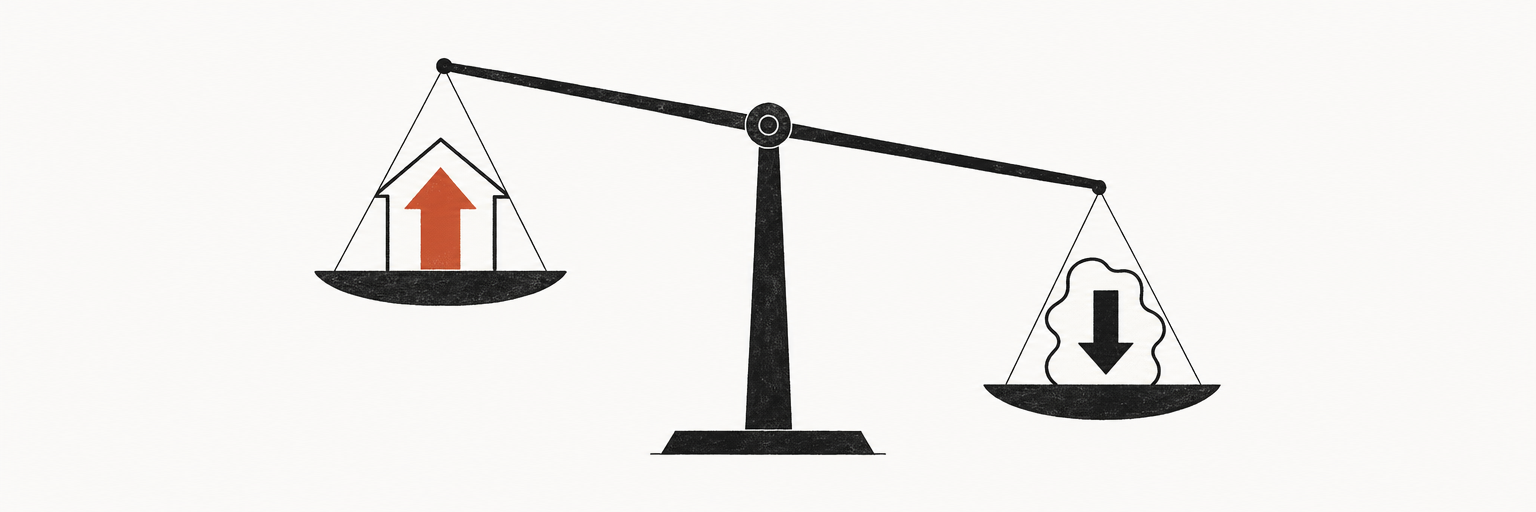
Good debt is borrowing used to acquire something that increases in value or generates income over time — a home that builds equity, an education that raises earning potential, a business loan that produces revenue. Bad debt is borrowing used to buy things that depreciate or provide no lasting financial return, typically at high interest rates.
The labels are useful shorthand, but they’re not a clean binary. The same type of debt can be good or bad depending on the terms and circumstances.
Common examples
| Debt type | Typically categorized as | Why |
|---|---|---|
| Mortgage | Good | Funds an appreciating asset; interest deductible in some cases |
| Student loans | Good (with caveats) | Funds education that may increase earnings |
| Small business loan | Good | Funds income-generating activity |
| Auto loan at low rate | Neutral | Funds a depreciating asset, but often necessary |
| Credit card balance | Bad | Funds consumption at high interest; no lasting value |
| Payday loan | Bad | Extremely high interest; funds consumption |
| Personal loan for vacation | Bad | Funds a consumed experience at interest cost |
The caveats on “good” debt
Fidelity’s analysis is direct: the good/bad distinction doesn’t mean good debt is free of risk.
Mortgages are considered good debt — but only if the payment is affordable. A mortgage that strains your monthly budget creates financial fragility. Real estate values don’t always rise. A home bought near a market peak with too little down payment became a serious problem for many homeowners during the 2008–2009 housing correction, when nationwide home prices fell roughly 20–30% from peak values (S&P/Case-Shiller index).
Student loans can be good debt — but return on investment varies enormously. As a rough illustration: a $30,000 loan for a degree that increases annual earnings by $20,000 pays off quickly; a $120,000 loan for a credential that offers modest income improvement may not. Experian notes the practical test: will the expected income increase justify the cost of the debt, including interest?
What actually matters more than the category
Interest rate. A credit card at 9% APR (rare, but possible) is less damaging than a student loan at 14%. The rate determines the cost of carrying the debt more than the category does.
Affordability. Debt that creates payment stress forces tradeoffs that compound over time — missed savings contributions, emergency fund depletion, increased reliance on other debt. Even “good” debt that stretches your budget creates real costs.
Whether the asset actually appreciates. Good debt is good because it funds something valuable. If the asset depreciates or the investment doesn’t produce the expected return, the category label doesn’t help.
The practical use of the distinction
The good/bad framing is most useful for making decisions, not categorizing existing debt:
- Before taking on debt: Does this fund something with lasting value? Is the interest rate proportionate to what I’m getting? Can I afford the payments comfortably?
- When prioritizing payoff: Pay off high-interest debt (bad debt, typically) before low-interest debt (good debt, typically). A 24% credit card costs more to carry than a 5% mortgage.
- When considering net worth: Debt used to acquire an asset appears on both sides of your balance sheet — the asset and the liability. Credit card debt used to fund consumption appears only as a liability.
One common mistake
Treating good debt as something that doesn’t need to be paid off. A mortgage is good debt, but carrying a 30-year mortgage into retirement creates income pressure on a fixed budget. Paying extra toward principal, when possible, converts interest costs into equity. Good debt still costs money; it just costs less than bad debt for something worth having.