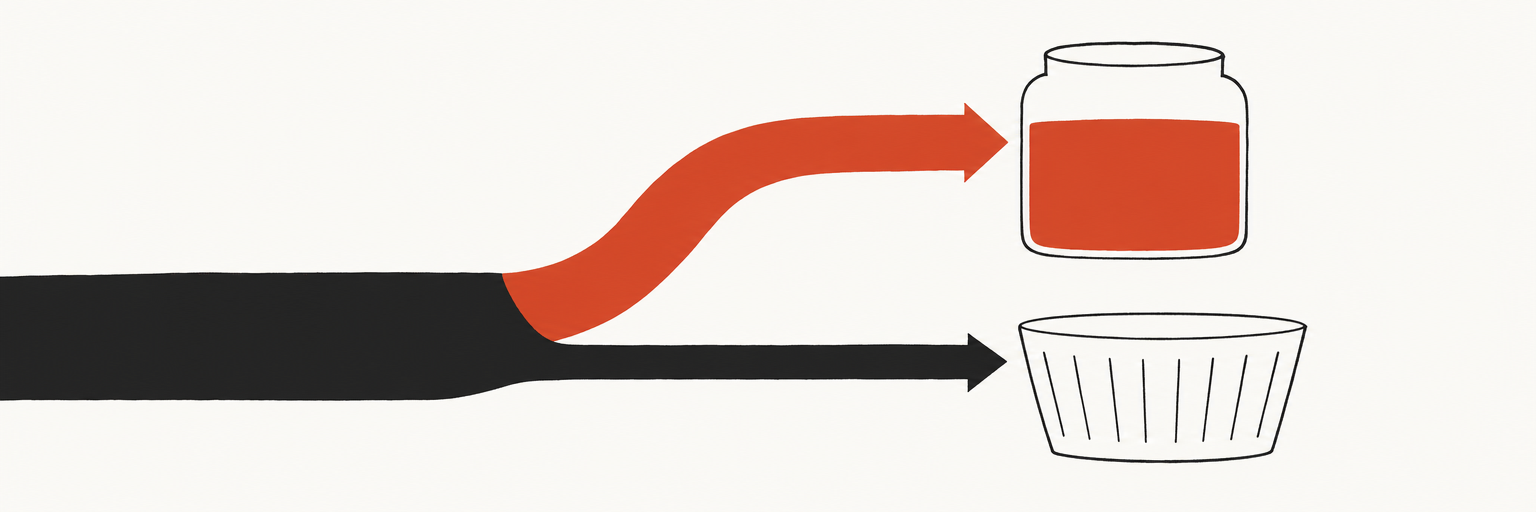
Pay yourself first is a savings strategy where you treat your own savings like a fixed bill — one that gets paid before rent, groceries, or anything else. The moment your paycheck arrives, a predetermined amount moves to savings automatically. What remains is what you have to spend. You never see the savings money in your checking account, so you never decide whether to spend it.
The Consumer Financial Protection Bureau describes it as “putting a portion of your paycheck automatically into savings” and notes that “saving automatically is one of the easiest ways to make your savings consistent so you start to see it build over time.”
Why “after I pay everything else” doesn’t work
Most people intend to save what’s left at the end of the month. In practice, discretionary spending expands to fill whatever is available. Bankrate’s 2026 Annual Emergency Savings Report found that only 41% of Americans could cover an unexpected $1,000 expense using savings — down from 44% the prior year and the lowest level since 2021 (source: bankrate.com/banking/savings/emergency-savings-report). One likely contributor is sequencing: when savings come last, they compete with every spending decision made that month. When savings come last, they compete with every spending decision made that month. When savings come first, they’re settled before spending begins.
How much to pay yourself first
Common starting points (illustrative — the right number depends on your income, expenses, and goals):
| Target | Monthly take-home of $4,000 | Notes |
|---|---|---|
| 5% | $200 | Realistic starting point for tight budgets |
| 10% | $400 | Common baseline recommendation |
| 15% | $600 | Toward retirement benchmarks |
| 20% | $800 | 50/30/20 rule’s savings target |
The CFPB does not prescribe a specific percentage, noting that “even a small amount can provide some financial security.” Ten to twenty percent is a widely cited range, but 1% is better than 0%. Start where your budget allows and increase by 1–2% annually — each raise is an opportunity to bump the savings rate before lifestyle adjusts to the higher income.
How to set it up
The mechanics are simple: schedule an automatic transfer from your checking account to a savings account for the day after your paycheck deposits. Most banks and credit unions support recurring transfers in their online settings. If your employer offers direct deposit split, even better — direct a fixed dollar amount to savings before the remainder hits checking at all.
Where you put the savings depends on the goal:
- Emergency fund — high-yield savings account or money market account at an online bank; keep it accessible but not convenient
- Retirement — 401(k) contribution via payroll (especially if your employer matches; matched dollars are an instant return on the contribution)
- Short-term goals — separate savings account or sinking fund, labeled for its purpose
Multiple destinations work simultaneously. A common structure: 5–10% to a 401(k), 3–5% to an emergency fund until it’s fully funded, then redirect that portion toward the next goal.
What to do when money is too tight
If your budget genuinely can’t absorb any savings transfer, the pay-yourself-first amount starts at whatever clears without creating overdrafts — sometimes $25 or $50. The habit matters more than the amount at the beginning. Most people find that adjusting spending around a small transfer is easier than they expected once they stop seeing that money in checking. The amount can grow; the habit is harder to build from scratch later.
Common mistakes
Making it manual. Transfers that depend on remembering to initiate them most months don’t happen. Automation is the point. Set it once and let it run.
Using a savings account at your primary bank. When savings and checking live at the same institution, the transfer is one click away from reversal. Many people find an online-only bank with a 2-day transfer window meaningfully reduces the temptation to move money back.
Stopping after hitting one goal. Once your emergency fund is fully funded, redirect that automatic transfer rather than letting it dissolve into spending. The system is already built — just change the destination.
Where to start
Log in to your bank today, find the recurring transfer or automatic savings feature, and set up a transfer for the day after your next paycheck. Start with an amount you’re confident your budget can absorb — $50, $100, whatever that is. You can always increase it. The worst outcome is that you start too small; the best outcome is you never notice it’s gone and your savings grows anyway.