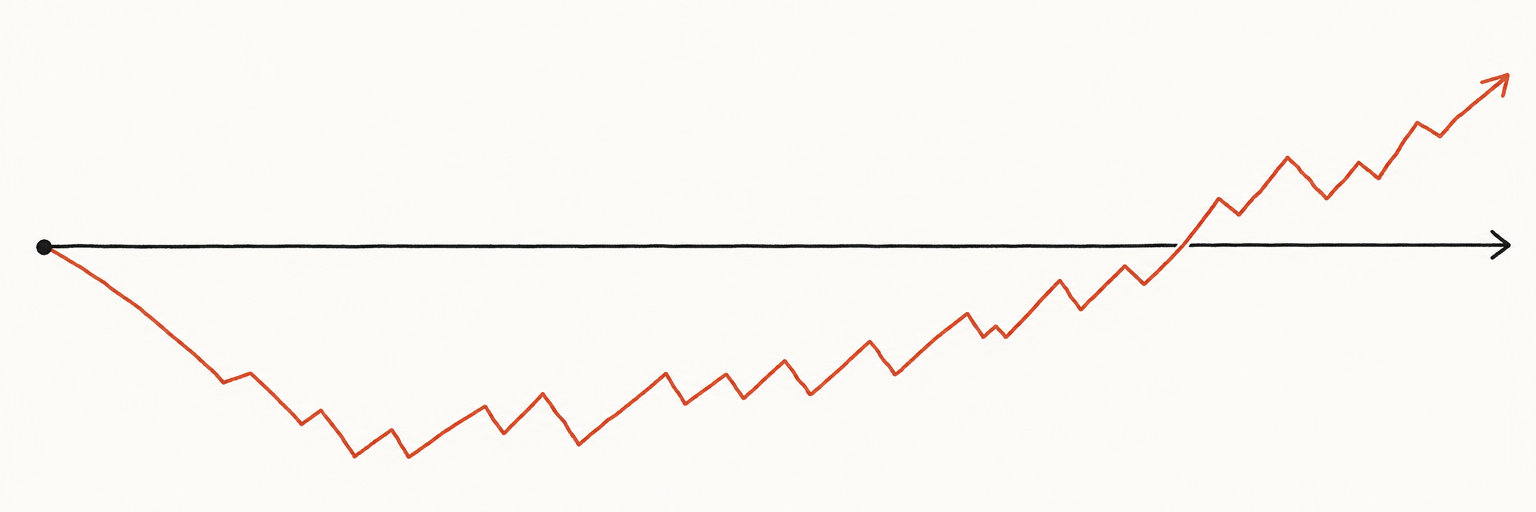
Saving and investing are both ways to build wealth, but they serve different purposes and carry very different risk profiles. Saving means placing money in a protected account where the principal is safe and accessible — a savings account, CD, or money market account. Investing means buying assets — stocks, index funds, bonds, real estate — where the value can rise and fall, with the expectation of higher long-term growth. Knowing which to use, and when, is one of the most fundamental decisions in personal finance.
Side-by-side comparison
| Saving | Investing | |
|---|---|---|
| Goal | Short-term, specific goals | Long-term wealth building |
| Time horizon | Days to ~5 years | 5+ years |
| Typical products | Savings accounts, CDs, money market accounts | Stocks, index funds, ETFs, bonds |
| Risk of loss | None (FDIC-insured up to $250,000) | Yes — value can fall, even to zero |
| Typical return | 0.38% national avg; up to 5.00% APY (HYSA, April 2026) | ~10% nominal / ~7% real annually (S&P 500, long-term) |
| Liquidity | High — accessible immediately or within days | Varies — stocks sell quickly, but value may be down |
| Principal guarantee | Yes (FDIC-insured institutions) | No |
| Best for | Emergency fund, down payment, near-term goals | Retirement, long-term wealth accumulation |
The return gap is enormous
The numbers make the trade-off concrete. According to Fidelity, the S&P 500 has returned an average of approximately 10% annually since 1957 — roughly 7% after adjusting for inflation.
Compare that to savings accounts: the national average savings rate sits at just 0.38% APY as of April 2026, according to FDIC data. Even the best high-yield savings accounts (HYSAs) are currently offering up to 5.00% APY — excellent for their purpose, but less than half the historical stock market average.
Over 20 years, starting with $10,000:
| Vehicle | Rate | Balance after 20 years |
|---|---|---|
| National avg savings account | 0.38% | ~$10,770 |
| High-yield savings account | 4.50% | ~$24,100 |
| S&P 500 index fund (avg) | 10% nominal | ~$67,300 |
The difference between a savings account at the national average and a broad market index fund is over $56,000 on a $10,000 starting balance — before any additional contributions.
The inflation problem with saving too much
Cash loses purchasing power over time. At a 3% annual inflation rate — roughly the U.S. historical average — $10,000 today has the purchasing power of only about $7,440 in 10 years. Leave that money in an account earning 0.38% APY and you’ve effectively lost ground every single year.
A high-yield savings account earning 4.5–5% APY currently outpaces inflation, which is why HYSAs are appropriate for emergency funds and near-term goals right now. But that relationship shifts with interest rate cycles — and over decades, the stock market’s real return of ~7% has consistently beaten inflation in a way savings accounts have not.
When to save (not invest)
Put money in a savings account or CD when:
- You need it within 5 years
- Losing any of it would be catastrophic (emergency fund, rent, down payment)
- The goal is specific, time-bound, and dollar-defined
- You’re building the 3–6 month emergency fund that must be liquid and risk-free
The emergency fund is non-negotiable: it belongs in a savings account, not the stock market. A portfolio can drop 30–40% in a recession — exactly when you’re most likely to need the money.
When to invest (not save)
Put money in an investment account when:
- The money won’t be needed for 5 years or more
- You can tolerate seeing the balance drop by 20–40% temporarily without panicking
- The goal is retirement, long-term wealth, or generational assets
- You’ve already secured your emergency fund and cleared high-interest debt
Time is the primary ingredient. The same $500/month invested at 8% average annual return over 30 years grows to roughly $745,000. Waiting 10 years to start and investing $500/month for only 20 years yields roughly $294,000 — less than half — even though you’ve only missed a decade.
The key risk difference: FDIC vs no guarantee
FDIC insurance covers savings accounts, CDs, and money market accounts at member banks up to $250,000 per depositor, per institution. If the bank fails, the federal government makes you whole. There has not been a single dollar of FDIC-insured deposits lost since the program began in 1933.
Investments have no such guarantee. A stock can lose 50% of its value. An entire sector can collapse. Diversified index funds have always recovered over long enough time horizons historically, but there is no guarantee. That’s why time horizon is the most critical variable — invest money you genuinely won’t need for years, so you can wait out downturns without being forced to sell.
The sequence that makes sense for most people
The decision isn’t binary — most people should do both. The order matters:
- $1,000 starter emergency fund — in a savings account, before anything else
- Employer 401(k) match — invest enough to capture the full match (an instant 50–100% return)
- Full 3–6 month emergency fund — in a HYSA earning competitive APY
- Pay off high-interest debt — anything above 6–7% APR is a guaranteed return
- Invest aggressively — Roth IRA (2026 limit: $7,500), 401(k) beyond the match, then taxable brokerage
Steps 1 and 3 are saving. Steps 2 and 5 are investing. You don’t choose one permanently — you do both, in the right sequence, for the right goals.
Common mistakes
Keeping too much in savings. Once you have 3–6 months of expenses in a HYSA, additional cash held in savings is losing real purchasing power annually. The opportunity cost of not investing is real and compounding.
Investing money you need soon. Putting a house down payment or a car fund in the stock market and needing it during a downturn forces you to sell at a loss. If you need the money in under 5 years, it belongs in savings.
Waiting for the “right time” to invest. There’s no perfect entry point. The cost of waiting — lost compound growth — typically exceeds the risk of buying before a short-term dip.
Ignoring HYSA rates. The national savings account average of 0.38% APY is far below what competitive online banks offer. If your emergency fund sits in a brick-and-mortar savings account earning 0.01%, switching to a HYSA can earn you hundreds of dollars more each year for zero additional risk.
The next action
Open a high-yield savings account for your emergency fund if you don’t have one. Once it holds 3–6 months of expenses, open a Roth IRA at Fidelity, Vanguard, or Schwab — all charge no fees to open — deposit whatever you can, and buy a total market index fund. That’s the entire structure most people need.